
White-tailed eagle
Haliaeetus albicilla
A broad, patient shape on a rock or riding the air above the fjord. The eagles keep their own hours, so no sighting is ever a promise.
Least Concern (IUCN, 2021) means it is not close to being threatened. After heavy persecution and pesticide losses, numbers across Europe have recovered strongly since the 1970s.


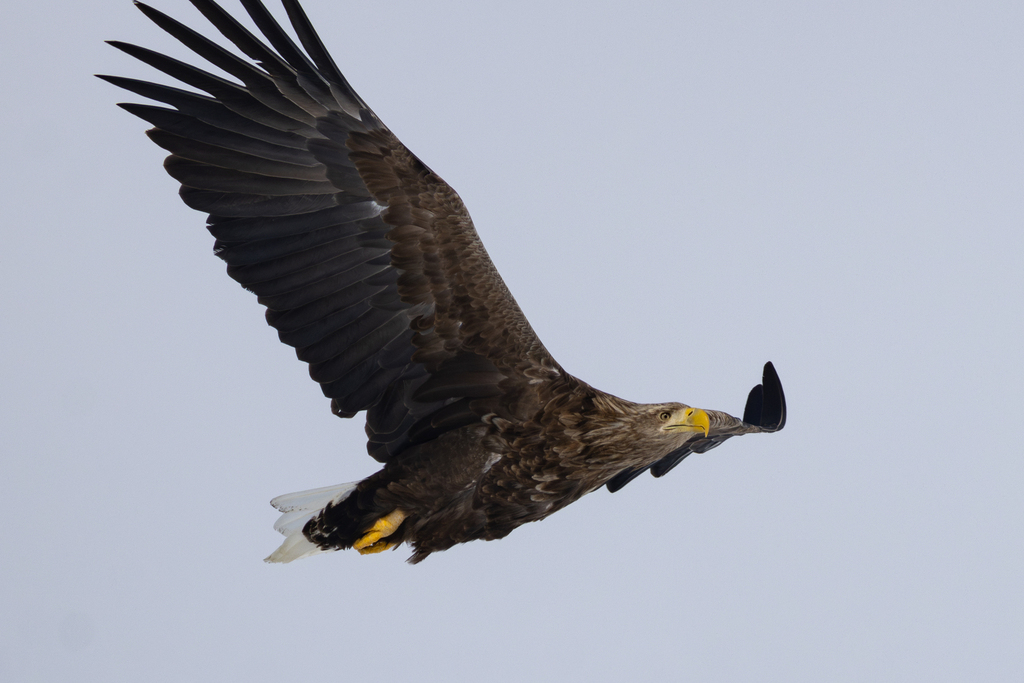
Photos show the species, not always the places on this page.
Length
Body length about 66 to 94 cm (26 to 37 in). Wingspan about 1.78 to 2.45 m (5 ft 10 in to 8 ft), with records up to about 2.6 m (8.5 ft).
Weight
Females about 4 to 6.9 kg (8.8 to 15.2 lb) and males about 3.1 to 5.4 kg (6.8 to 11.9 lb), with an overall average of about 5 kg (11 lb).
Next to a person
The wings spread about as wide as a tall adult's outstretched arms, up to nearly 1.5 times a person's height, and an average bird weighs about as much as a bowling ball.
What it eats
Mostly fish and waterbirds, with small mammals and carrion too, especially in winter. It hunts from a perch or on the wing, catching fish near the surface with its talons, and it seldom takes fish in water deeper than about 1.5 to 2 m. In Norway, eiders are an important prey in some areas.
Around people
Calm, give space
How it lives
Pairs usually mate for life and keep the same territory. They nest in old trees, on sea cliffs and sometimes on human structures, and nests can reach about 1.8 m across. Birds mature at about 5 to 6 years and reach full adult plumage at about 8. Young birds are much darker brown, while adults have a paler head and a white wedge-shaped tail. An eagle may spend up to 90% of a day perched, especially in poor weather.
Where it goes
A partial migrant. Birds in the western part of its range, including Norway, are mostly resident, and young birds move more than adults. Young birds leave their birth area around August to September, and Norwegian juveniles have been recorded up to about 720 km to the south. In winter, groups of up to 30 to 50 can gather in Scandinavia.
We only draw a journey on the map when scientists have tracked it or clearly documented it. For this animal we have not found one yet.
Populations
Least Concern (IUCN, 2021). Europe's breeding pairs rose from about 715 in 1950 to 1965 to about 12,280 in 2018 to 2024, after persecution and pesticide losses. Norway protected the species in 1968. The 2021 Norwegian Red List classes it as Least Concern, with about 5,600 to 8,400 individuals in 2015 and an increasing trend, and 25 to 50% of the global population. Growth has levelled off in places: around Steigen in Nordland, nests peaked at 119 in 2003 and 46 were recorded in 2023, linked to competition for food and nest sites and warmer seas. In Scotland, a reintroduction using Norwegian birds began in the 1970s, and the RSPB reports fewer than 150 pairs in the UK.
Meet it respectfully
Watch from a distance and stay quiet. Eagles avoid areas of heavy disturbance, so keep well back from nests and perches, and never feed, bait or flush a bird for a photograph. Rules differ by country: in the UK, disturbing the species is illegal. Follow local rules and your guide. No one can promise an eagle on a given day.
Fun fact
Tap the bulb to light it up.
It may have the largest wingspan of any living eagle.
Scottish white-tailed eagles descend from birds brought from Norway in a reintroduction that began in the 1970s.
On a quiet day an eagle may spend most of its time perched, watching the water for fish.
White-tailed eagle in the Ocean Atlas
Places we have researched where this animal is recorded. It is never guaranteed, and some places are for watching from the boat only.
Travel with usComing soonTrusted referralExploringOn pause, story onlyEthics pass
Country colour: pink where we travel, blue where we are exploring or refer, grey for story only.
 Belgium
 Bulgaria
 China
China Croatia
 Denmark
 Estonia
 Finland
 France
 Georgia
 Germany
 Greece
 Greenland
 Iceland
 India
India Iran
Iran Ireland
 Israel
 Italy
Italy Japan
Japan Kuwait
 Latvia
 Lithuania
 Montenegro
 Netherlands
 Norway
 Poland
 Romania
 Russia
 Slovenia
 South Korea
 Spain
Spain Sweden
 Taiwan
 Thailand
 Türkiye
 Ukraine
 United Kingdom
 United States
Sources for this page
- Wikipedia, White-tailed eagle
- RSPB, White-tailed eagle
- Forskersonen, population in Norway and Europe
- Artsdatabanken, Norwegian Red List, 2021
- Forestry and Land Scotland, White-tailed eagle
- GBIF, IUCN category lookup
Facts checked 5 October 2026. Photos: Unsplash licence, or Creative Commons as shown on each photo.
Work in ocean travel?
We are always happy to hear from exceptional local operators, accommodation, conservation organisations and destination experts. If your work fits responsible, small-group ocean travel, we would love to learn more.
Partner with Ocean Calling5-day freediving course in Bali
CHF 1,180