
Southern stingray
Hypanus americanus
Southern stingrays often disappear into the sand until only their eyes show. We give them room and let the ray move first.
Near Threatened (IUCN, 2020) means it is close to becoming threatened.
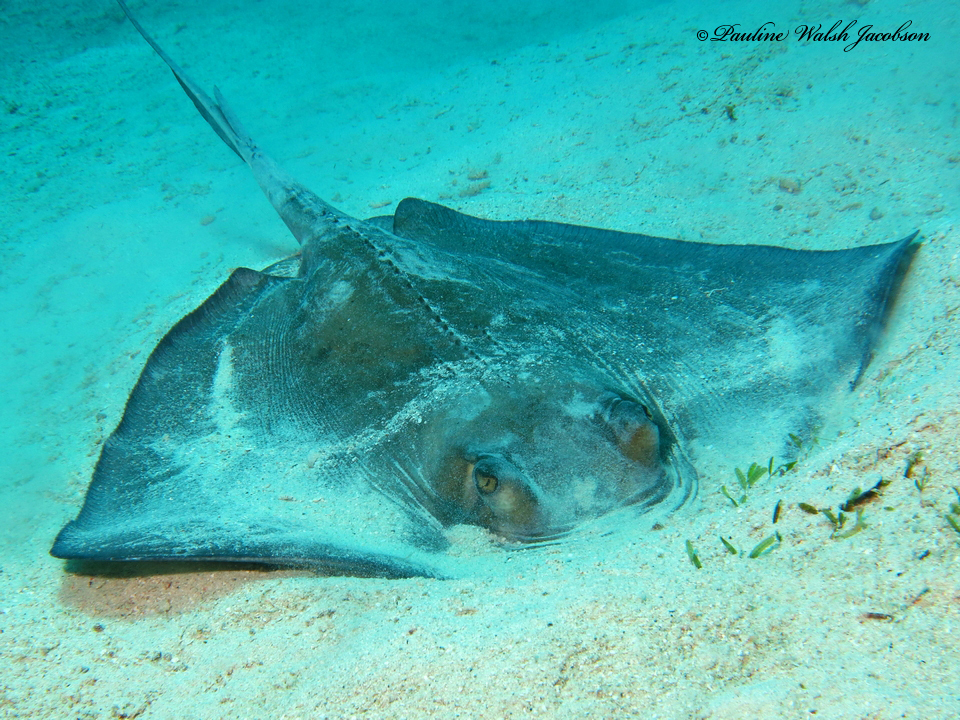
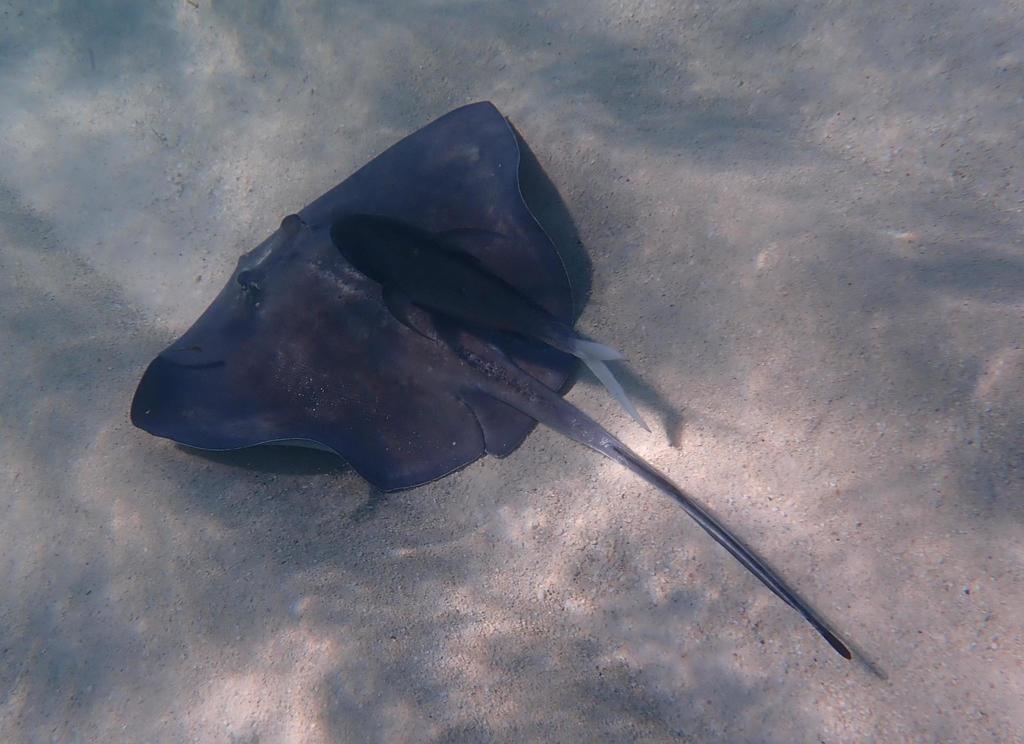
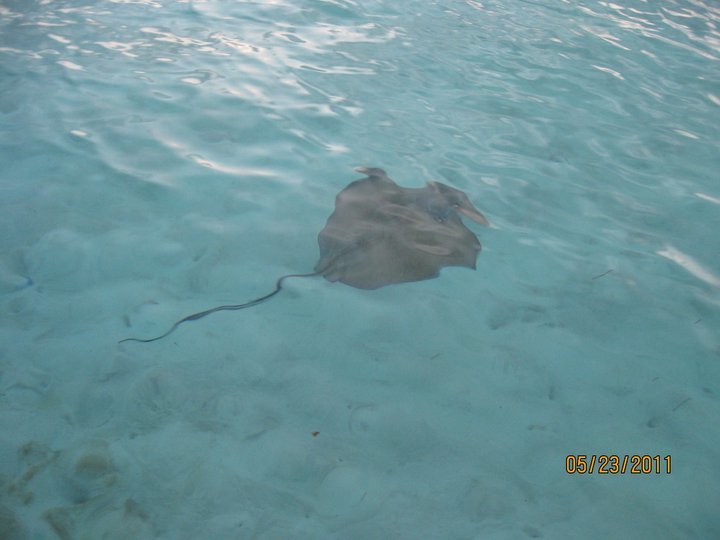
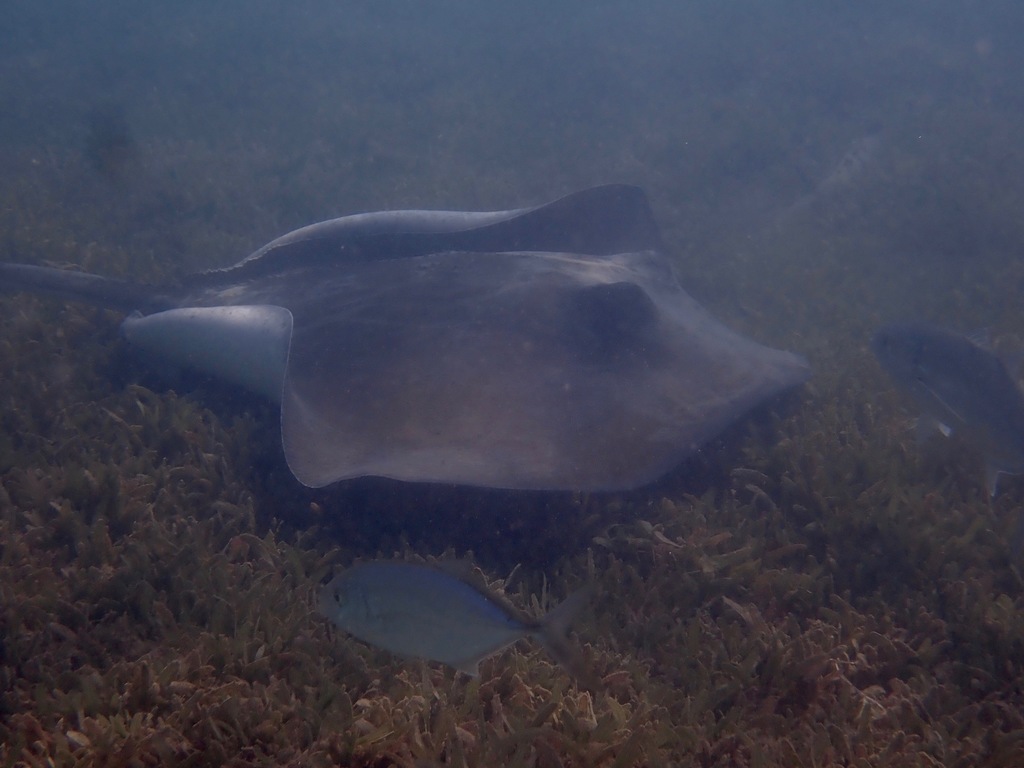
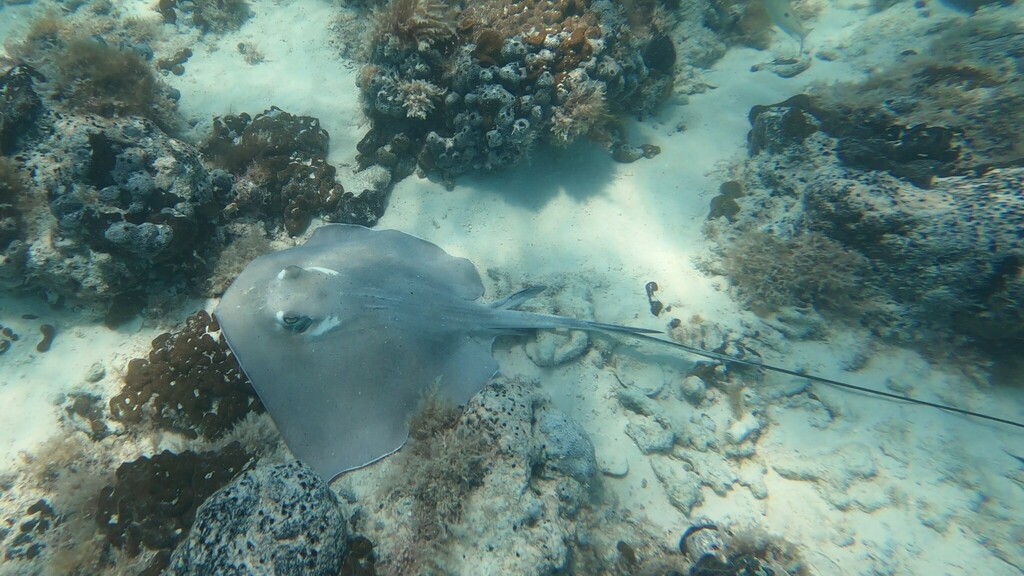
Photos show the species, not always the places on this page.
Length
Most adults are smaller; largest recorded disc about 2 m (6.6 ft) across
Weight
Typical weight not reliably measured; largest published about 136 kg (300 lb)
Next to a person
The biggest are about as wide as a short adult is tall
What it eats
Mainly clams and worms, plus shrimps, crabs and small fish. It digs them out of the sand, mostly at night.
Around people
Defensive if pressured
How it lives
This ray lives on sandy bottoms and seagrass near reefs, mangroves and estuaries. In the wild it mostly hunts at night and rests by day, often buried in sand. It is usually alone or in pairs, but can gather in groups. Females give birth to a small litter of live pups, often 3 or 4.
Where it goes
It is a stay at home ray, and long distance migration is not known. Around Cape Eleuthera, Bahamas, over a third of 200 marked rays were found again, and females kept small home ranges. In St Thomas, US Virgin Islands, young rays stayed in the same bays for 256 days on average.
We only draw a journey on the map when scientists have tracked it or clearly documented it. For this animal we have not found one yet.
Populations
Found in the western Atlantic, from the United States through the Caribbean and Gulf of Mexico to Brazil. At Stingray City Sandbar in Grand Cayman, where rays have been fed by tourists for decades, at least 164 rays were counted in 2002 to 2003, over 80% female. The count fell to 57 in 2012, then rose to about 90. These rays do not show normal wild behaviour.
Meet it respectfully
Shuffle your feet when you wade in sandy shallows so rays can swim away. Give the ray a clear escape route and never touch, lift, feed or corner it. Its tail spine is venomous and can cause serious injury if a ray is stepped on or grabbed. Ocean Calling does not visit places where rays are fed and handled for tourists. In the Cayman Islands, feeding or touching rays outside the official Wildlife Interaction Zones is not allowed.
Fun fact
Tap the bulb to light it up.
Southern stingrays leave pits in the sand when they dig for worms and shellfish.
The tail spine is for defence, not for hunting.
Young wild rays in the US Virgin Islands can stay in the same bays for months.
At Stingray City in Grand Cayman, rays fed by tourists since 1986 turned their day upside down: they became active by day and quiet at night, the opposite of wild rays nearby.
Source: Corcoran et al., 2013, PLOS ONE, supplemental feeding and southern stingrays at Grand Cayman
Fed rays at Stingray City used a daily area about seven times smaller than wild rays, 0.13 km2 against 0.88 km2.
Source: Corcoran et al., 2013, PLOS ONE, supplemental feeding and southern stingrays at Grand Cayman
Blood tests showed that rays at the tourist site had lower antioxidant defences and more injuries and parasites than rays at quiet sites around Grand Cayman.
Source: Semeniuk et al., 2009, Biological Conservation, blood health of stingrays at tourist sites
Southern stingray in the Ocean Atlas
Places we have researched where this animal is recorded. It is never guaranteed, and some places are for watching from the boat only.
Travel with usComing soonTrusted referralExploringOn pause, story onlyEthics pass
Country colour: pink where we travel, blue where we are exploring or refer, grey for story only.
 Anguilla
 Antigua and Barbuda
 Aruba
 The Bahamas
 Barbados
 Belize
 Brazil
 British Virgin Islands
 Caribbean Netherlands
 Cayman Islands
 Colombia
 Costa Rica
 Cuba
 Curaçao
 Dominica
 Dominican Republic
 Guadeloupe
 Honduras
 Jamaica
 Martinique
 Mexico
 Panama
 Puerto Rico
 Saint Barthélemy
 Saint Kitts and Nevis
 Saint Lucia
 Saint Martin
 Saint Vincent and the Grenadines
 Sint Maarten
 Trinidad and Tobago
 Turks and Caicos Islands
 United States
 US Virgin Islands
Sources for this page
- Save Our Seas Foundation, Southern stingray (IUCN status, size, biology)
- Corcoran et al., 2013, PLOS ONE, supplemental feeding and southern stingrays at Grand Cayman
- Semeniuk et al., 2009, Biological Conservation, blood health of stingrays at tourist sites
- Stingray City Sandbar monitoring, 2016 to 2017, Proceedings of the Gulf and Caribbean Fisheries Institute 69
- Schwanck et al., 2020, Journal of Fish Biology, southern stingrays at Cape Eleuthera, Bahamas
- Legernes, Nemeth and Legare, 2024, Estuarine, Coastal and Shelf Science, southern stingrays in St Thomas
- FishBase, 2025, Hypanus americanus
- Cayman Islands Department of Environment, Marine Manners
Facts checked 26 September 2026. Photos: Unsplash licence, or Creative Commons as shown on each photo.
Work in ocean travel?
We are always happy to hear from exceptional local operators, accommodation, conservation organisations and destination experts. If your work fits responsible, small-group ocean travel, we would love to learn more.
Partner with Ocean CallingNew: tiger sharks in Fuvahmulah, January or March 2027
from CHF 2,900