
Portuguese man o' war
Physalia physalis
Not a true jellyfish, but a floating colony with a blue sail. Admire it from the beach and never pick it up, even when stranded.
Not Evaluated means IUCN has never assessed the Portuguese man o' war.
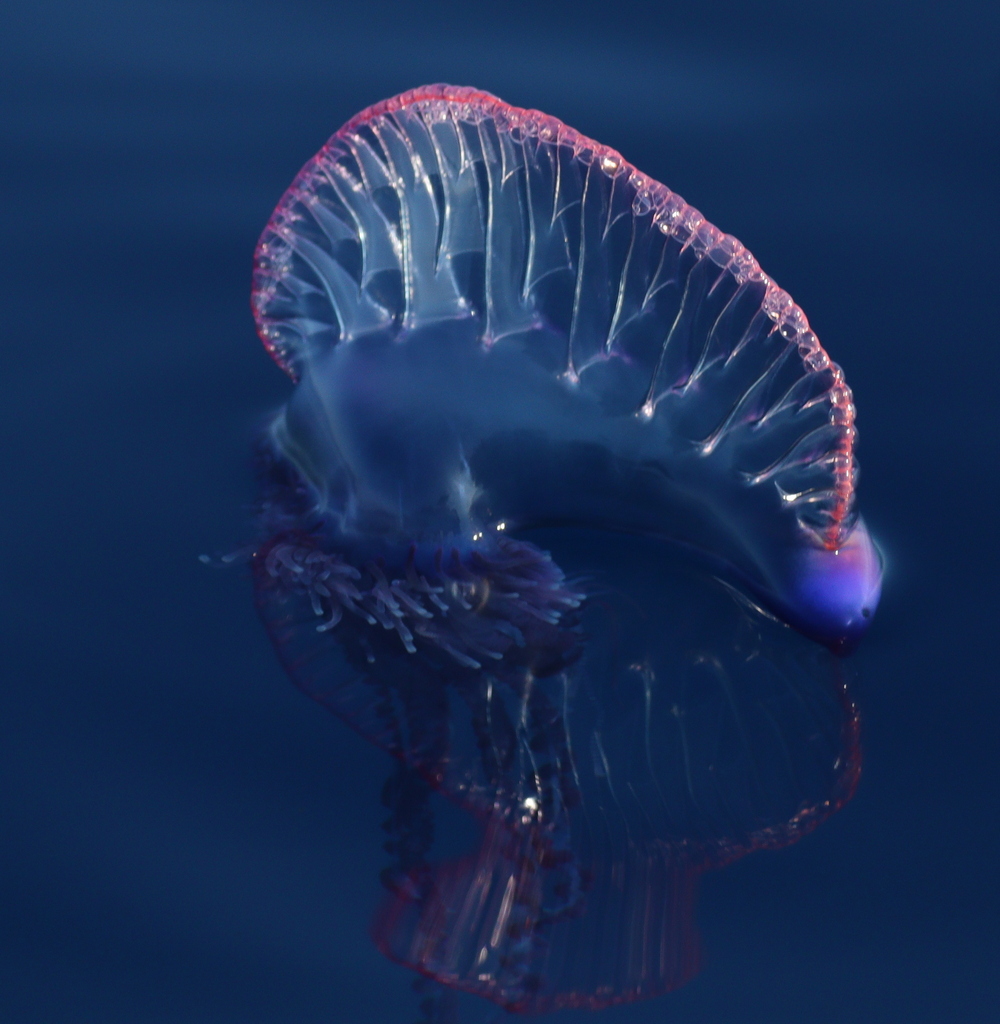
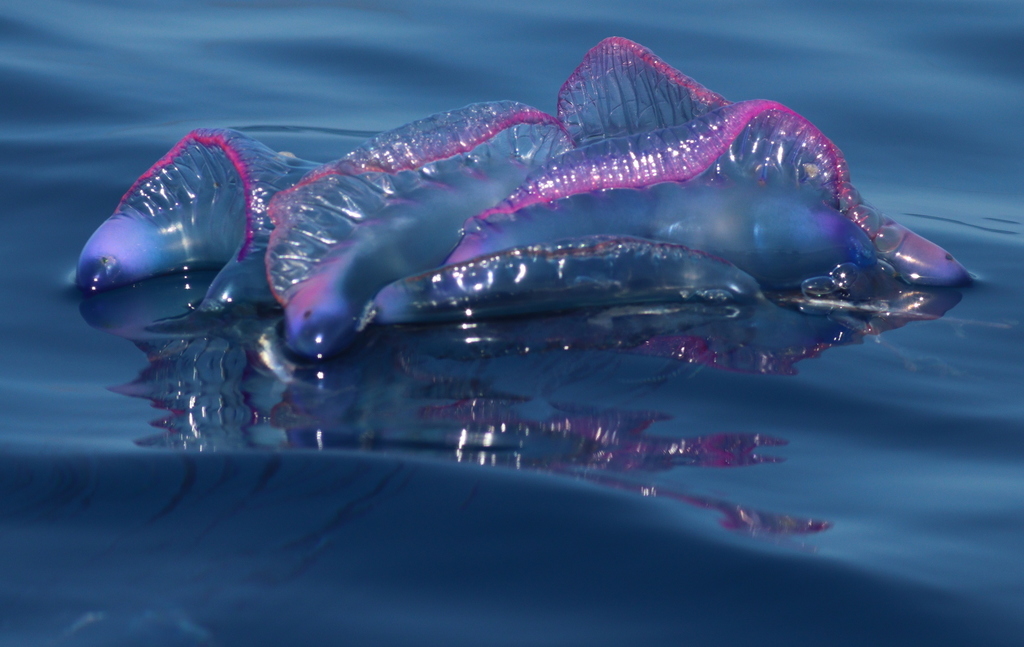
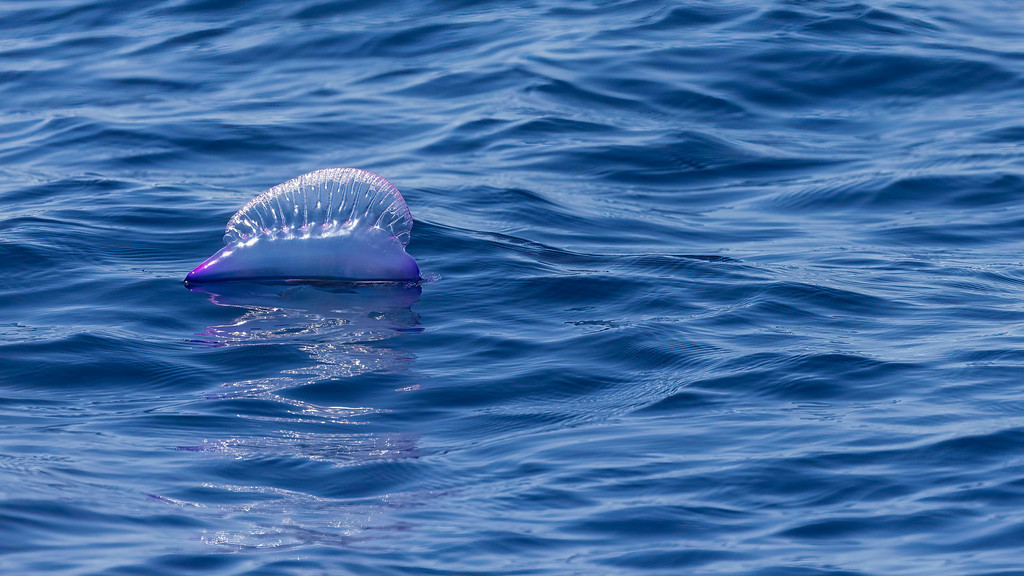
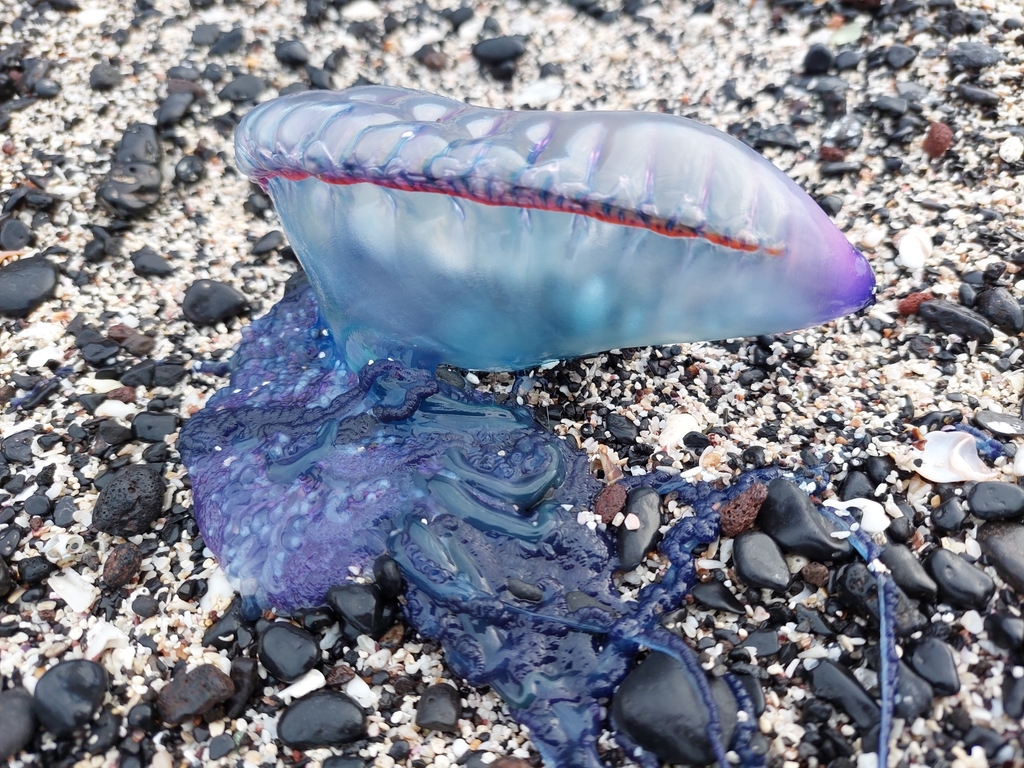
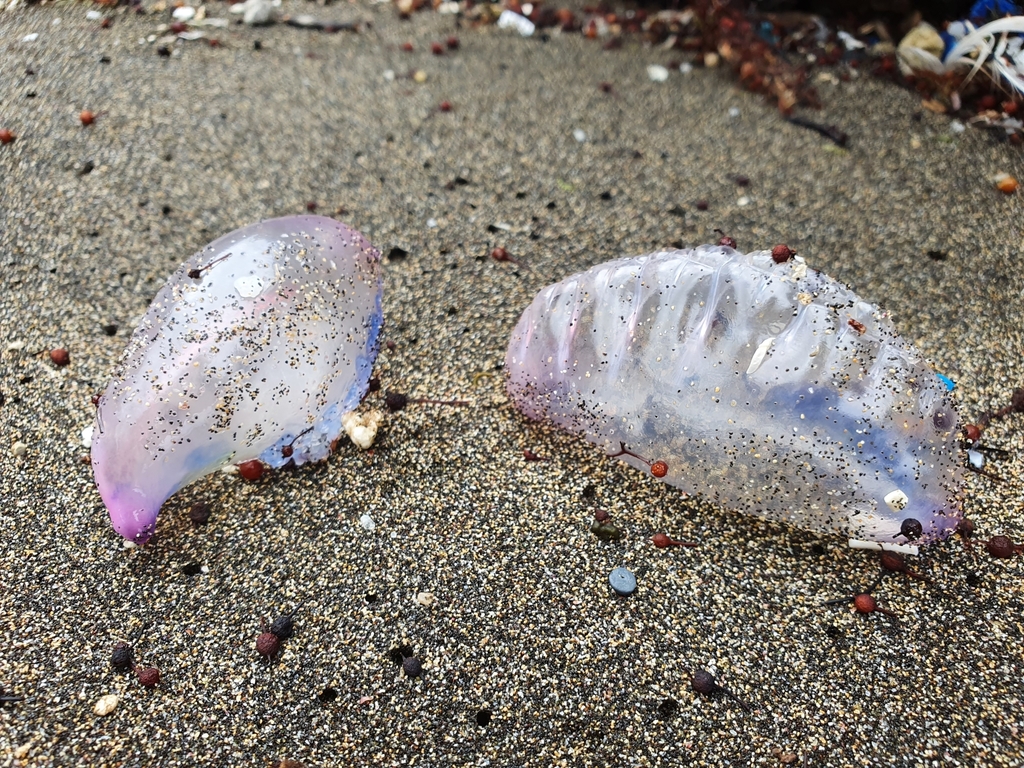
Photos show the species, not always the places on this page.
Length
Float up to about 15 cm (6 in) above the water. Tentacles average about 10 m (33 ft); rare reports say up to about 30 m (100 ft)
Weight
Not reliably measured
Next to a person
Float about the size of a hand; tentacles can trail many metres behind
What it eats
Small fish, young fish and small crustaceans near the surface, caught with its stinging tentacles.
Around people
Potentially dangerous, respect
How it lives
The man o' war is a siphonophore: a colony of many specialised parts that work as one animal. A gas float acts as a sail, so it moves only with wind and current, sometimes in groups of 1,000 or more. Its sting is very painful but rarely deadly. In 2025, a large genetic study suggested there are at least four species, but not all scientists agree yet.
Where it goes
It drifts, it does not migrate. Wind and currents push fleets onto Atlantic shores. In summer 2010, unusual winter weather carried Atlantic man o' war into the Mediterranean, with swarms off Spain; scientists concluded it was a one-off event, not a permanent invasion.
We only draw a journey on the map when scientists have tracked it or clearly documented it. For this animal we have not found one yet.
Populations
Man o' war are at least four species: Physalia physalis, P. utriculus, P. megalista and P. minuta (found in Australia and New Zealand). Australian 'bluebottles' can belong to other species than the Atlantic man o' war.
Meet it respectfully
We watch from the beach and never pick one up. Do not touch floats on the beach, they can sting for weeks. First aid advice differs and experts do not agree: Australian guidance says pick off tentacles, rinse with seawater, no vinegar, then hot water (43 to 45°C) for up to 30 minutes. A 2017 Hawaiʻi study found vinegar then hot water worked better. Call emergency services for a large sting or a sting on the face, throat or eyes. This is not medical advice, follow local lifeguards.
Fun fact
Tap the bulb to light it up.
It is not a true jellyfish, but a colony of many specialised parts working as one.
Some colonies sail to the left and some to the right, so they drift differently in the same wind.
Blue by-the-wind sailors (Velella) and blue buttons (Porpita) often wash up with it, but they are different animals.
A stranded man o' war can still sting you weeks after it washed up on the beach.
Source: NOAA Ocean Service
In summer 2010, man o' war swarms reached the Mediterranean after an unusual winter in the North-East Atlantic. It was a casual visit, not a new home.
What we call one man o' war is at least four species, found by comparing the genes of 151 animals from around the world.
Source: Oceanographic, 2025, on Church et al., Current Biology
Portuguese man o' war in the Ocean Atlas
Places we have researched where this animal is recorded. It is never guaranteed, and some places are for watching from the boat only.
Travel with usComing soonTrusted referralExploringOn pause, story onlyEthics pass
Country colour: pink where we travel, blue where we are exploring or refer, grey for story only.
 Australia
 The Bahamas
 Bermuda
 Brazil
 Cabo Verde
 Canada
 Chile
Chile Colombia
 Costa Rica
 Cuba
Cuba Ecuador
 France
 French Guiana
 Guam
Guam Hong Kong
 India
India Indonesia
 Ireland
 Japan
Japan Kenya
Kenya Mexico
 Mozambique
 New Caledonia
 New Zealand
 Norfolk Island
 Portugal
 Seychelles
 South Africa
 Spain
Spain Taiwan
 Tanzania
 Thailand
 Trinidad and Tobago
 United Kingdom
 United States
 Uruguay
Sources for this page
- NOAA Ocean Service, What is a Portuguese man o' war?
- ANZCOR Guideline 9.4.5, First aid management of marine envenomation
- University of Hawaiʻi SOEST, man o' war first aid study (Toxins, 2017)
- Prieto et al., 2015, Scientific Reports
- Oceanographic, 2025, on Church et al., Current Biology
- Church et al., 2025, Current Biology
- Australian Museum, 2026, Bluebottle
Facts checked 26 September 2026. Photos: Unsplash licence, or Creative Commons as shown on each photo.
Work in ocean travel?
We are always happy to hear from exceptional local operators, accommodation, conservation organisations and destination experts. If your work fits responsible, small-group ocean travel, we would love to learn more.
Partner with Ocean CallingSwim with humpback whales in Moʻorea, September 2027
from CHF 4,500