
Queen conch
Aliger gigas
A pink-lipped shell on the sand, with two stalked eyes watching. Conch move slowly and on their own terms, and no sighting is ever a promise.
Near Threatened (IUCN, 2025) means it is not yet in a threatened category but is close to it, and its numbers are falling.
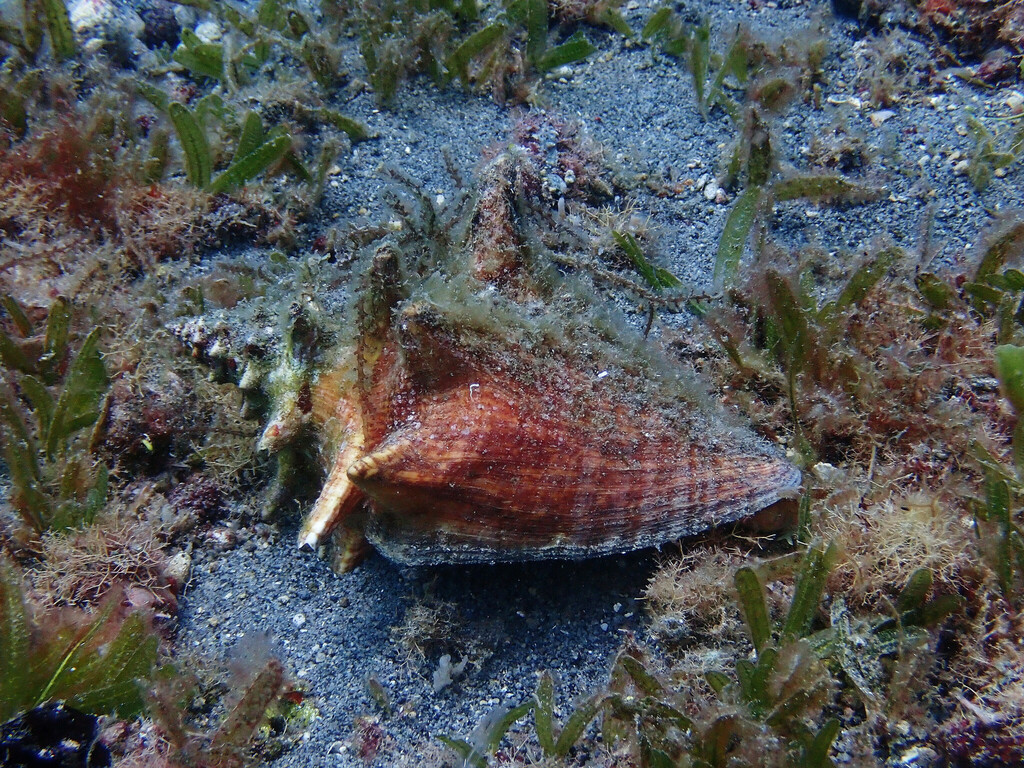
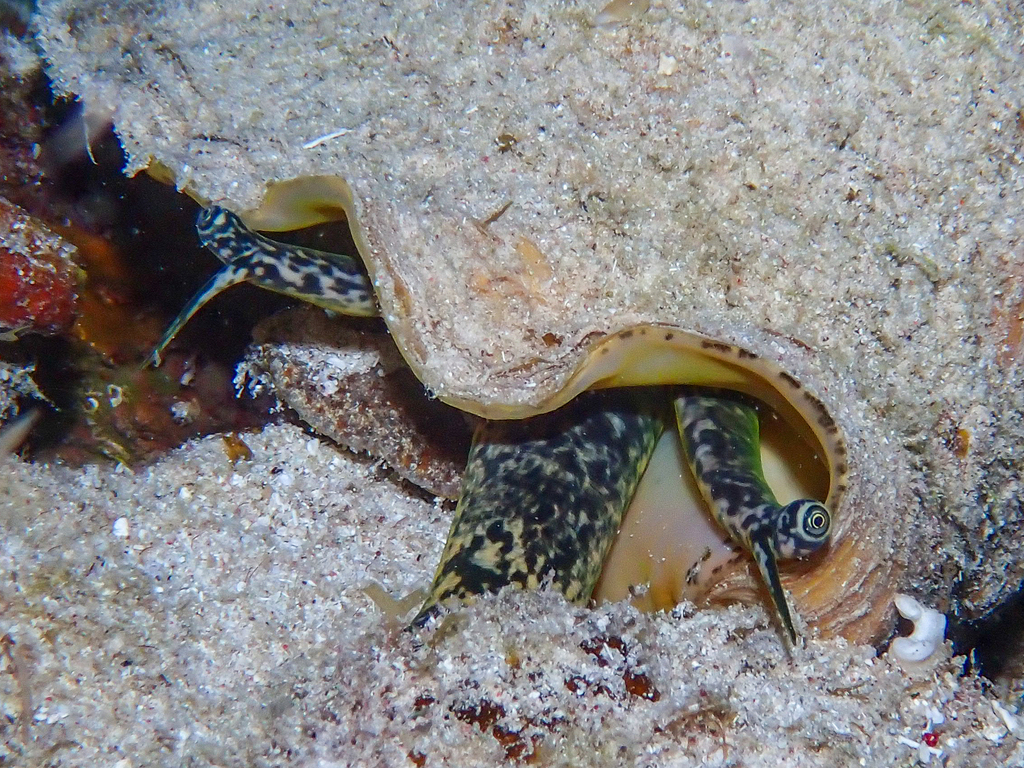
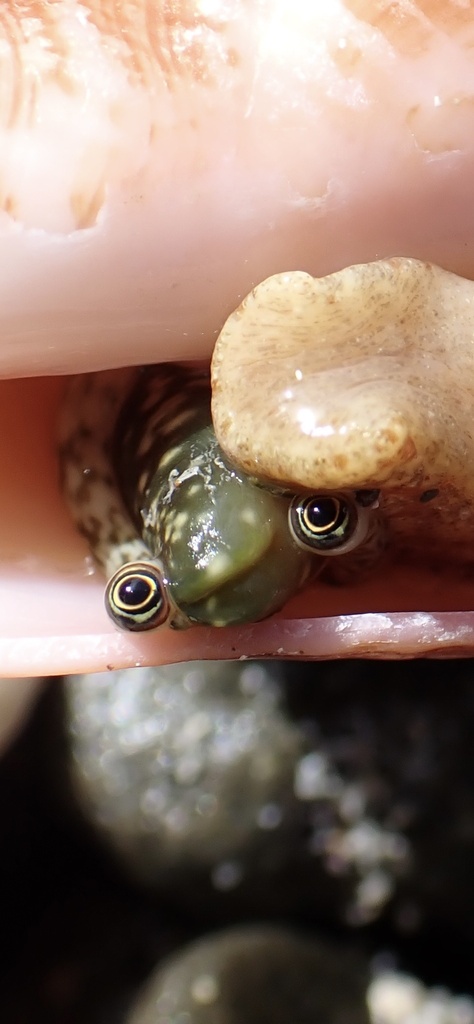
Photos show the species, not always the places on this page.
Length
Shell up to about 30 cm (12 in) per NOAA; up to about 35 cm (13.9 in) in another reference
Weight
Up to about 2.3 kg (5 lb) per NOAA, with females on average larger and heavier than males
Next to a person
About as long as an adult forearm and hand, and roughly as heavy as a large bag of flour
What it eats
Algae and plant material. Adults graze filamentous and epiphytic algae, juveniles eat diatoms and fine algae on the sediment, and larvae feed on phytoplankton.
Around people
Look, do not collect
How it lives
Queen conch are slow-growing and long-lived, usually reaching 25 to 30 years. They mature at about 3.5 to 4 years. Once mature they stop growing longer and the shell lip only grows thicker. Mating needs direct contact, and the spawning season lasts 4 to 9 months. Each egg mass holds about 500,000 to 750,000 eggs, which hatch after about 5 days.
Where it goes
Queen conch move slowly along the seabed. Adults prefer sandy algal flats and are also found on gravel and rubble, while juveniles stay mostly in seagrass. The IUCN describes the species as gathering in groups and spreading out, and records it from the surface to about 90 m. Larvae drift in the water for 21 to 30 days before settling.
We only draw a journey on the map when scientists have tracked it or clearly documented it. For this animal we have not found one yet.
Populations
The IUCN assessed queen conch as Near Threatened in 2025, with a decreasing trend and about 743 million mature individuals across its range, which includes Mexico and Venezuela. In 2024 the United States listed it as Threatened under its Endangered Species Act, and international trade is controlled under CITES Appendix II. Overfishing is the main threat, and the species is slow to recover because it is slow-moving and needs close contact to mate.
Meet it respectfully
Look, do not collect. Leave live conch where they are, and do not pick up, move or turn them over. Do not buy or take shells without checking the rules, because international trade is controlled under CITES Appendix II. Float above the seagrass without kicking up sand or touching the seabed. Rules on conch differ by place, so follow local rules and your guide.
Fun fact
Tap the bulb to light it up.
Its eyes sit on long stalks that can move independently.
Once an adult, it stops growing longer and the shell lip just gets thicker.
Sea turtles and nurse sharks are among the predators that eat queen conch.
Queen conch in the Ocean Atlas
Places we have researched where this animal is recorded. It is never guaranteed, and some places are for watching from the boat only.
Travel with usComing soonTrusted referralExploringOn pause, story onlyEthics pass
Country colour: pink where we travel, blue where we are exploring or refer, grey for story only.
 Antigua and Barbuda
 Aruba
Aruba The Bahamas
 Barbados
 Belize
 Bermuda
 British Virgin Islands
 Caribbean Netherlands
 Cayman Islands
 Colombia
 Cuba
Cuba Curaçao
 Dominican Republic
 Grenada
 Guadeloupe
 Haiti
Haiti Honduras
 Jamaica
 Martinique
 Mexico
 Panama
 Puerto Rico
 Saint Kitts and Nevis
 Saint Lucia
 Saint Martin
 Saint Vincent and the Grenadines
 Sint Maarten
 Trinidad and Tobago
 Turks and Caicos Islands
 United States
 US Virgin Islands
 Venezuela
Sources for this page
Facts checked 5 October 2026. Photos: Unsplash licence, or Creative Commons as shown on each photo.
Work in ocean travel?
We are always happy to hear from exceptional local operators, accommodation, conservation organisations and destination experts. If your work fits responsible, small-group ocean travel, we would love to learn more.
Partner with Ocean CallingNew: mobula rays in La Ventana, May 2027
CHF 2,720