
Wilson's storm-petrel
Oceanites oceanicus
A tiny dark bird dancing over the swell with its feet on the water. A sighting is a pleasure of the day, never a promise.
Least Concern (IUCN, 2018) means it is not at high risk of extinction. The species is very numerous and found in all oceans except the north Pacific.
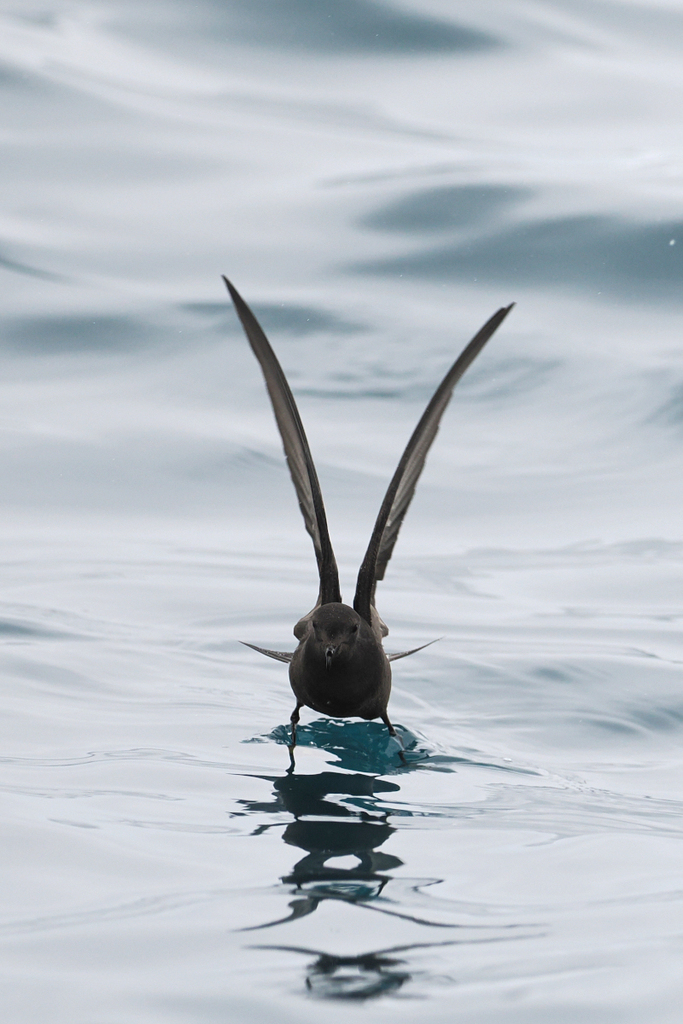
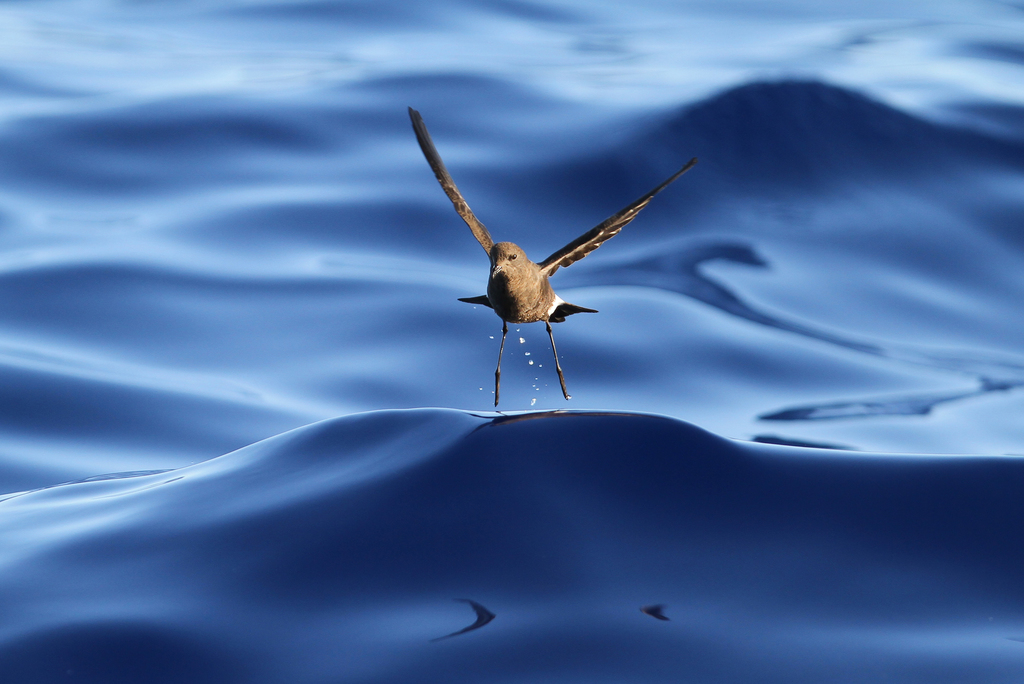
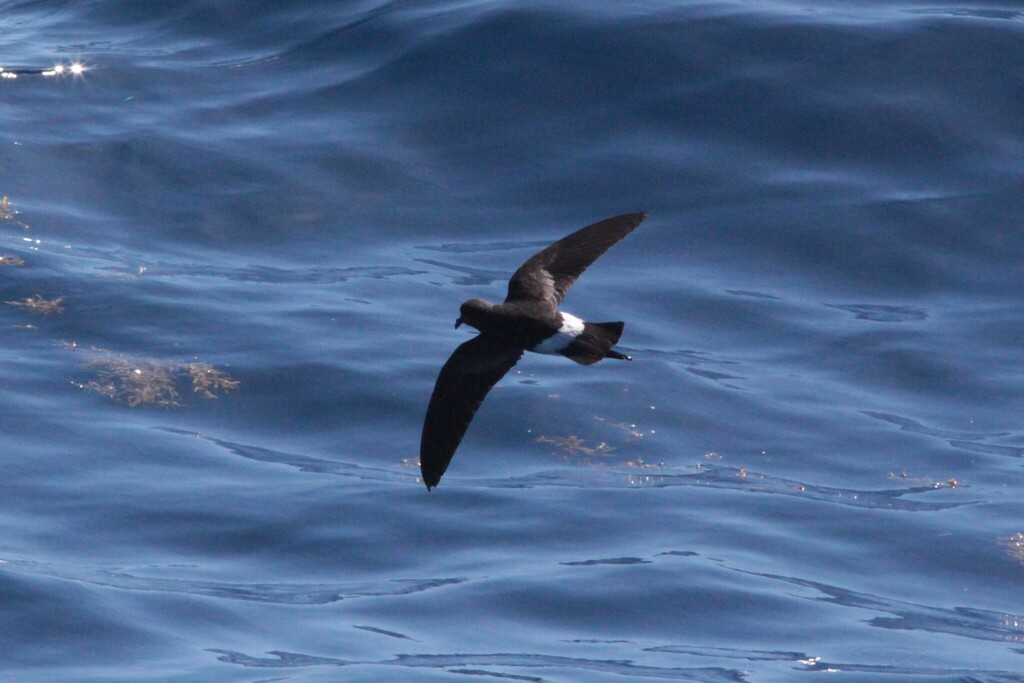
Photos show the species, not always the places on this page.
Length
About 16 to 18.5 cm (6.3 to 7.3 in) long, with a wingspan of about 38 to 42 cm (15 to 16.5 in).
Weight
About 40 g (1.4 oz) on average. Audubon gives 1.1 to 1.6 oz (31 to 45 g).
Next to a person
About the size of a robin or a sparrow, and lighter than a hen's egg.
What it eats
Mostly small drifting animals from the sea surface, such as krill and amphipods. It sometimes takes small fish 3 to 8 cm long, small squid and marine worms. It feeds on the wing, pattering on the water with its feet, and it follows ships and fishing boats. Audubon notes it also feeds at natural oil slicks.
Around people
Calm, give space
How it lives
Wilson's storm-petrels breed in colonies on the Antarctic coast and nearby islands. Audubon gives the breeding season as November to May. They nest in crevices, rock piles or burrows and lay a single white egg. They visit the colony only at night. Both parents feed the chick, which stays in the nest for about 60 days. Birds find their mates and burrows in the dark partly by smell. Lifespan was not given in the sources I opened.
Where it goes
This is a long-distance migrant. It breeds in the southern summer and moves north in the southern winter. It is found in all oceans except the north Pacific. From March to May many birds move north across the equator, and in summer they are common off eastern North America and in European waters.
We only draw a journey on the map when scientists have tracked it or clearly documented it. For this animal we have not found one yet.
Populations
Estimates are in the millions. Wikipedia gives 8 to 20 million birds (2022), and Audubon says more than 14 million. Birds of the World calls it one of the most abundant seabirds in the world. In East Antarctica, at Pointe Geologie, an unusually icy 2013 to 2014 summer caused total breeding failure, with no chick fledged, the lowest in 50 years of monitoring. Sources differ on whether there are two or three subspecies. IUCN assessed the species as Least Concern in 2018.
Meet it respectfully
Watch from a steady boat and keep your distance, especially near any feeding flock. Never chase the birds, throw bait or chum to attract them, or try to catch one. Follow your guide.
Fun fact
Tap the bulb to light it up.
It pats the water surface with its feet while feeding, which looks like dancing.
It is one of the most abundant seabirds in the world, with an estimated 8 to 20 million birds.
It finds mates and burrows in the dark partly by smell.
Wilson's storm-petrel in the Ocean Atlas
Places we have researched where this animal is recorded. It is never guaranteed, and some places are for watching from the boat only.
Travel with usComing soonTrusted referralExploringOn pause, story onlyEthics pass
Country colour: pink where we travel, blue where we are exploring or refer, grey for story only.
 Antarctica
 Argentina
 Australia
 The Bahamas
 Bangladesh
 Bermuda
 Brazil
 Canada
 Chile
Chile Falkland Islands
 France
 French Guiana
 Guadeloupe
 India
India Indonesia
 Ireland
 Israel
 Japan
Japan Kenya
Kenya Marshall Islands
 Mauritania
 Mexico
 Morocco
 Mozambique
 Namibia
 New Zealand
 Oman
Oman Peru
Peru Portugal
 Republic of the Congo
 Saint Helena
 Senegal
 Solomon Islands
 South Africa
 Spain
Spain Sri Lanka
 Taiwan
 United Arab Emirates
 United Kingdom
 United States
 Uruguay
Sources for this page
- Wikipedia, Wilson's storm petrel, 2026
- Audubon, Wilson's storm-petrel, 2026
- Birds of the World, Wilson's storm-petrel, 2026
- Royal Society Open Science, sea ice and seabirds, 2015
- Ecology and Evolution, Antarctic snow storms, 2015
- GBIF, IUCN Red List category, 2026
Facts checked 5 October 2026. Photos: Unsplash licence, or Creative Commons as shown on each photo.
Work in ocean travel?
We are always happy to hear from exceptional local operators, accommodation, conservation organisations and destination experts. If your work fits responsible, small-group ocean travel, we would love to learn more.
Partner with Ocean CallingNew: mobula rays in La Ventana, May 2027
CHF 2,720