
Bryde's whale
Balaenoptera edeni
Some Bryde's whales stay in warm waters all year and often feed near the surface, so watch for bait balls and diving seabirds.
Least Concern (IUCN, 2017) means it is not at high risk of extinction worldwide today.

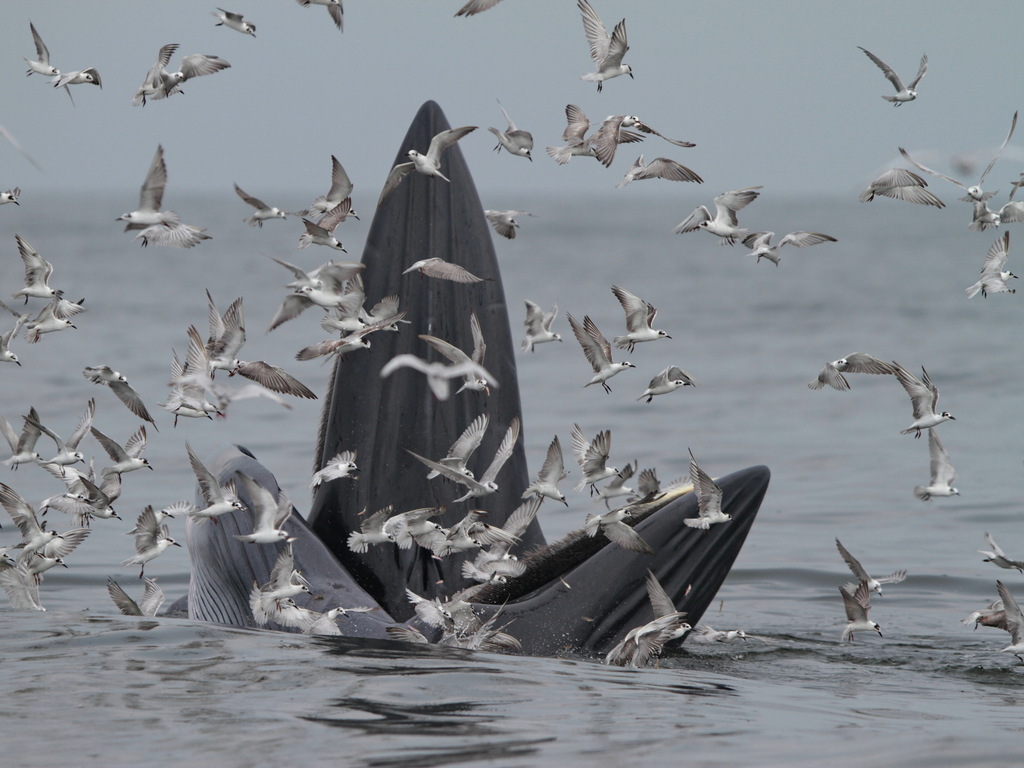
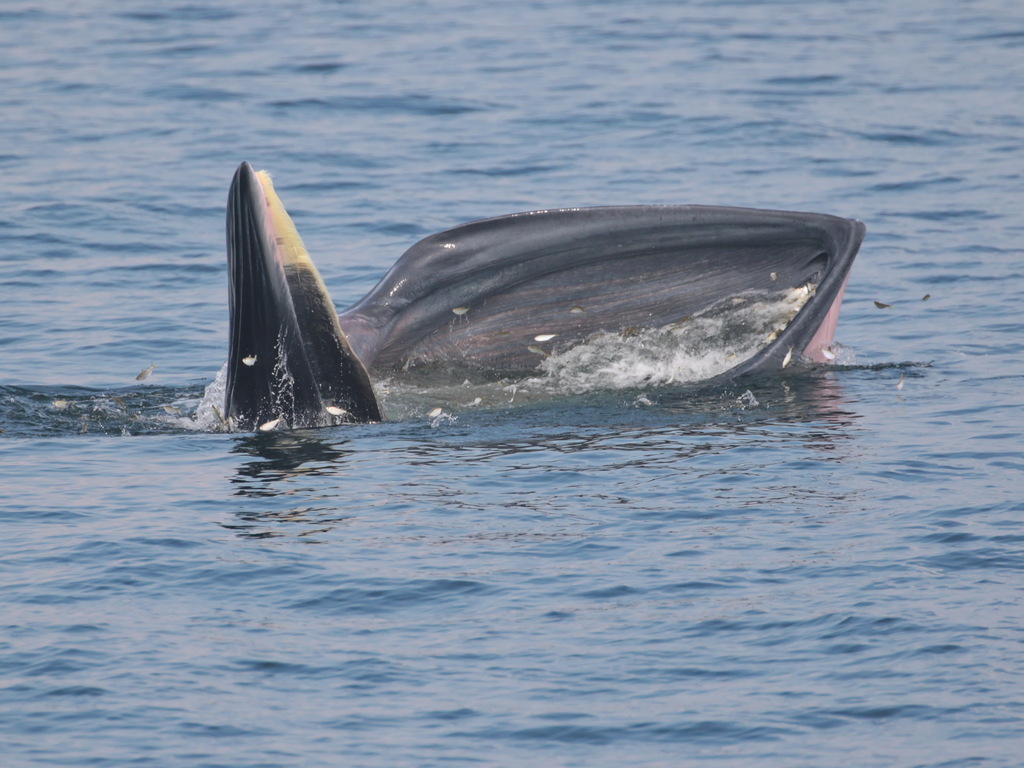
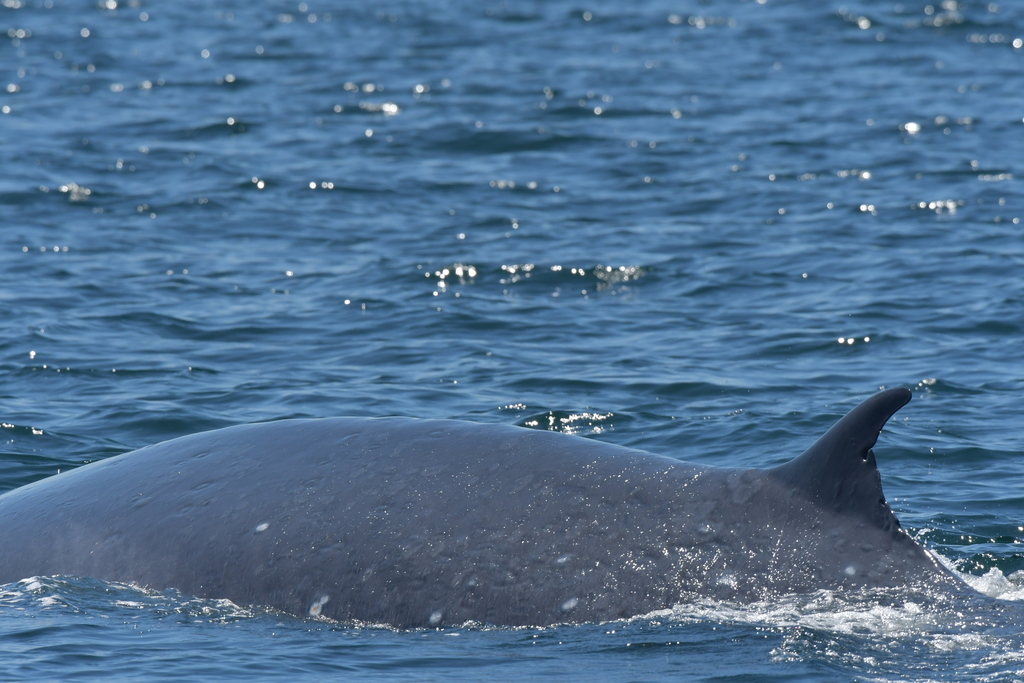
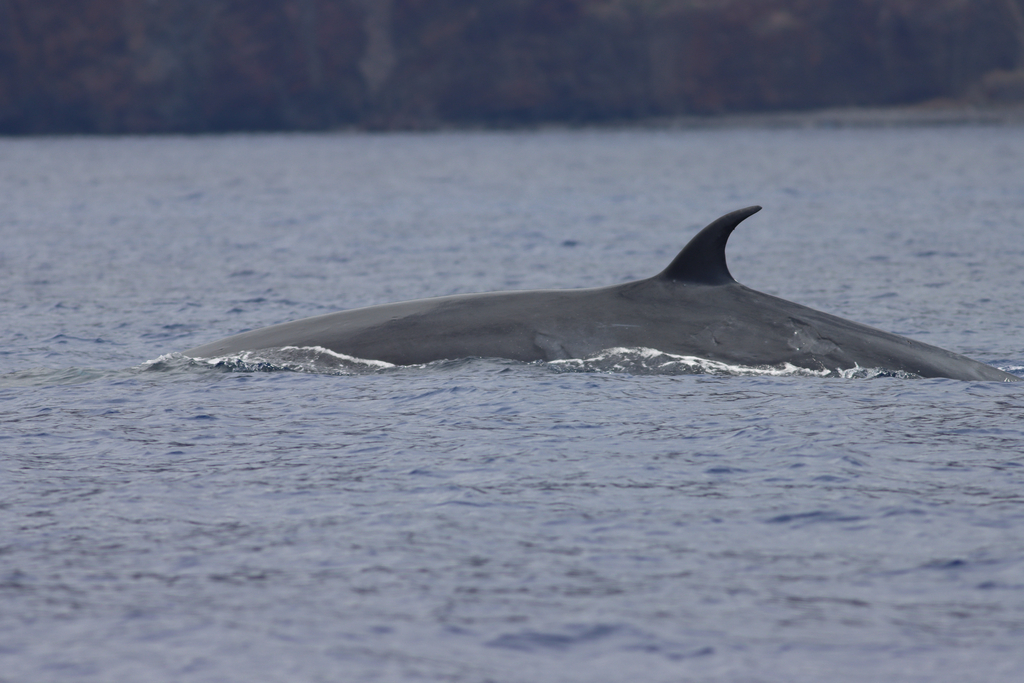
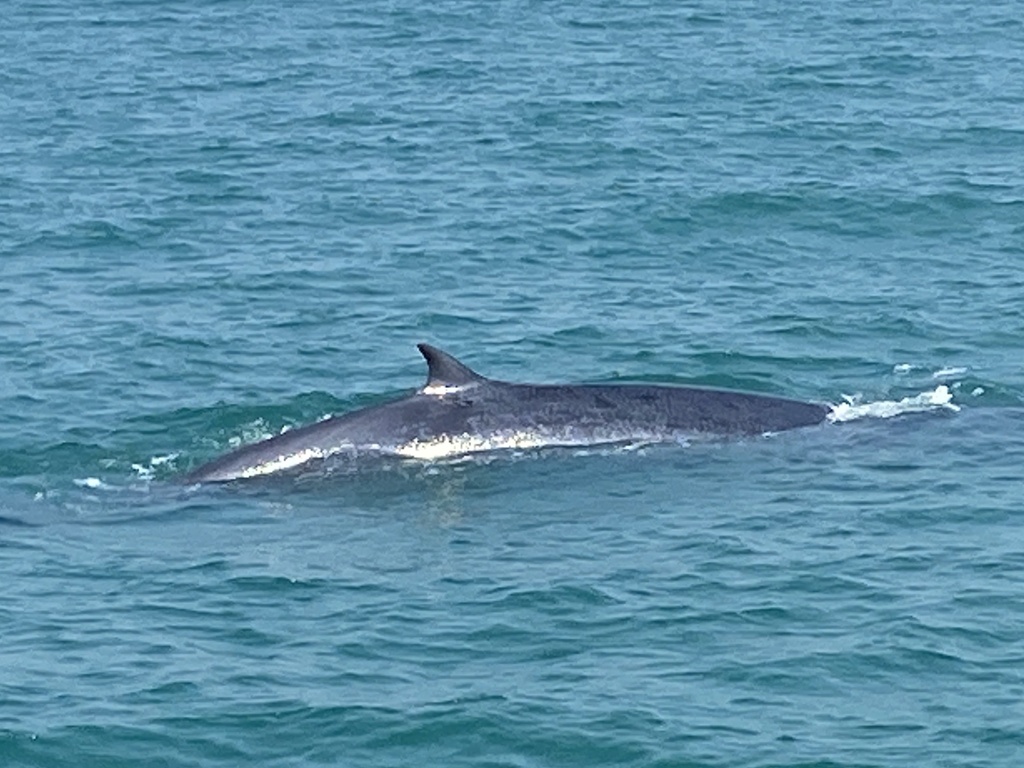
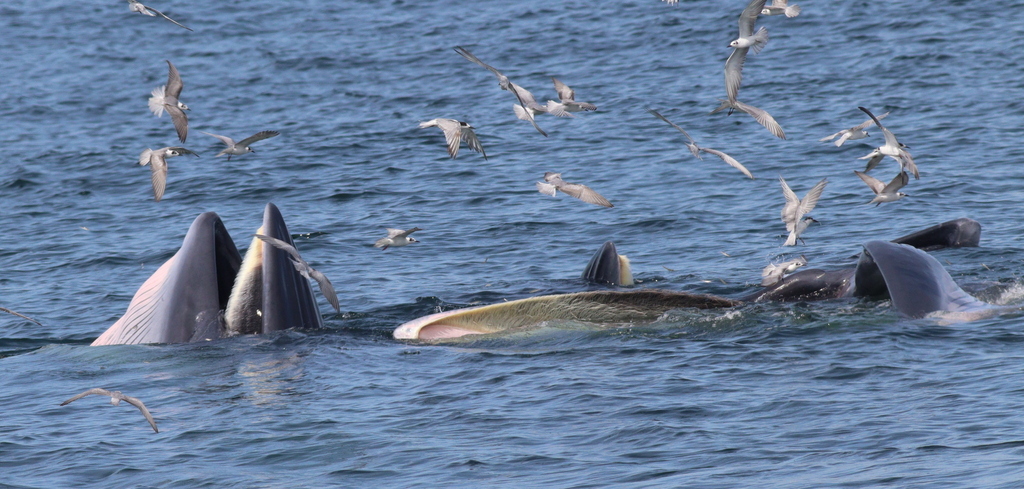
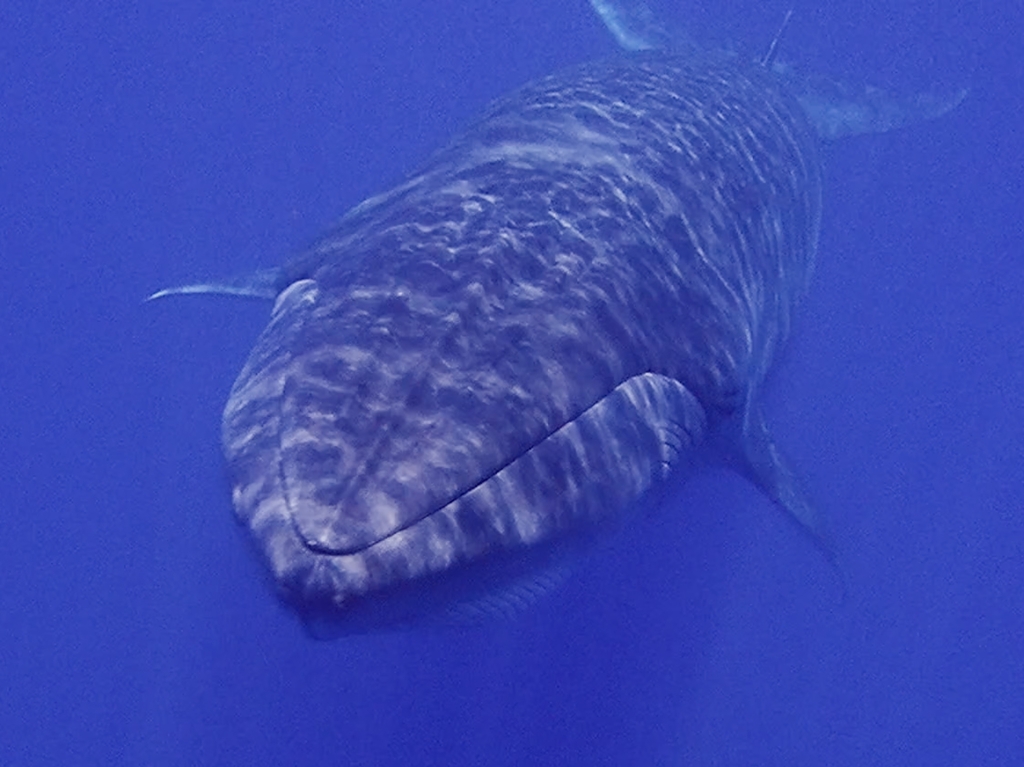
Photos show the species, not always the places on this page.
Length
Adults about 12.2 to 16.8 m (40 to 55 ft)
Weight
About 41 tonnes (90,000 lb)
Next to a person
About 7 to 10 adults lying head to toe
What it eats
Schooling fish such as sardines, pilchards, herring and mackerel, plus krill, copepods, shrimp and red crabs.
Around people
Calm, give space
How it lives
Bryde's whales feed on schooling fish, krill and other small animals. They use different methods in different places, such as lunging, skimming the surface and, in some areas, bubble nets. They are usually seen alone or in pairs, though loose groups can gather where food is rich.
Where it goes
Unusually for a baleen whale, some populations stay in warm waters all year, while others make only short seasonal moves. Around Madeira, 59 whales were photo-identified over 14 years and many came back in later years, some after 12 years; seven of them were also photographed in the Canary Islands. Whales tagged in Tosa Bay, Japan, mostly stayed in the same coastal waters for weeks in summer, and none crossed the Kuroshio Current. About 50 whales live in New Zealand's Hauraki Gulf all year.
Populations
Bryde's whale taxonomy is still not settled. For now, the smaller Eden's whale and the larger Bryde's whale are treated as two forms of one species. The Gulf of Mexico whale is a separate species, Rice's whale, named in 2021, and only about 50 remain. Populations differ a lot: a small coastal group in the upper Gulf of Thailand feeds with its mouth open at the surface, South Africa has an inshore form that follows sardines, and New Zealand's Hauraki Gulf has whales all year. Timor-Leste's whale guide lists Bryde's whale, but how often it is seen there is unknown.
Meet it respectfully
We watch only from the boat. Go slowly with a good lookout, because these whales often feed near the surface and can turn fast. Never chase them, block their path or drive through bait balls. Rules differ by place. New Zealand law asks boats to stay at least 50 m away, with no more than three boats within 300 m, and bans swimming with whales. In South Africa, boats without a whale watching permit must stay 300 m away, and in Madeira boats may not come closer than 50 m. In Sri Lanka, rules ask boats to switch off engines within 100 m, and watchers may not enter the sea. In Spain, including the Canary Islands, boats stay outside 60 m and swimming or diving in that zone is not allowed. In Vietnam, local guidance asks for at least 100 m.
Fun fact
Tap the bulb to light it up.
Unlike most large baleen whales, some Bryde's whale populations stay in warm waters all year.
Rice's whale in the Gulf of Mexico was once counted as a Bryde's whale. It is its own species, with only about 50 left.
Scientists still debate how the smaller Eden's whale and the larger Bryde's whale are related.
Look closely at its head. Most rorqual whales have one ridge on the snout, but Bryde's whales have three ridges running in front of the blowhole.
This whale carries the name of Johan Bryde, a Norwegian who built the first whaling stations in South Africa in the early 20th century.
In the upper Gulf of Thailand, Bryde's whales were seen 'tread-water feeding' 58 times. A whale lifts its head, opens its mouth at the surface and waits a few seconds for small fish to flow in.
Source: Iwata et al., 2017, Current Biology, tread-water feeding of Bryde's whales
In New Zealand's Hauraki Gulf, ships slowing from 14 to 10 knots cut the chance that a strike kills a whale from about 70% to 26%.
Source: Department of Conservation New Zealand, 2021, Bryde's whales of the Hauraki Gulf
Follow its journey
Watch it travel. Every line comes from satellite tracking or documented research, and the source is named.
StartEndJourney (the line joins documented areas; real paths vary)
Bryde's whale in the Ocean Atlas
Places we have researched where this animal is recorded. It is never guaranteed, and some places are for watching from the boat only.
Travel with usComing soonTrusted referralExploringOn pause, story onlyEthics pass
Country colour: pink where we travel, blue where we are exploring or refer, grey for story only.
 Angola
 Australia
 Bangladesh
 Brazil
 Chile
Chile China
China Costa Rica
 Curaçao
 Ecuador
 El Salvador
 Guadeloupe
 Guam
Guam Guatemala
 India
India Japan
Japan Kenya
Kenya Mexico
 Myanmar
 Namibia
 New Zealand
 Nicaragua
 Northern Mariana Islands
 Pakistan
 Panama
 Peru
Peru Portugal
 Qatar
Qatar Senegal
 South Africa
 Spain
Spain Sri Lanka
 Thailand
 Togo
Togo United States
 Venezuela
 Vietnam
Sources for this page
- NOAA Fisheries, 2026
- Ferreira et al., 2021, Aquatic Conservation, Bryde's whales in the North-East Atlantic: site fidelity and connectivity
- Kishiro, 2018, satellite tracking of coastal Bryde's whales off southwest Japan
- Iwata et al., 2017, Current Biology, tread-water feeding of Bryde's whales
- Department of Conservation New Zealand, 2021, Bryde's whales of the Hauraki Gulf
- NOAA Fisheries, Rice's whale
- IWC Whale Watching Handbook, New Zealand
- IWC Whale Watching Handbook, South Africa
- IWC Whale Watching Handbook, Sri Lanka
- Spain, Real Decreto 1727/2007 on the protection of cetaceans (BOE)
Facts checked 26 September 2026. Photos: Unsplash licence, or Creative Commons as shown on each photo.
Work in ocean travel?
We are always happy to hear from exceptional local operators, accommodation, conservation organisations and destination experts. If your work fits responsible, small-group ocean travel, we would love to learn more.
Partner with Ocean CallingShop with Ocean Calling
Visit the Ocean Calling storefront on Amazon.
As an Amazon Associate I earn from qualifying purchases. You are not only choosing products that respect the ocean, you are also helping us keep going: paying our local partners fairly and keeping our retreats ethical, sustainable and honestly priced for you. 💗