
Great frigatebird
Fregata minor
A forked tail and long, angled wings high above the reef. A frigatebird overhead is a lucky moment, never a promise.
Least Concern (IUCN, 2020) means it is not at high risk of extinction overall. The Brazilian subspecies F. m. nicolli is Critically Endangered.
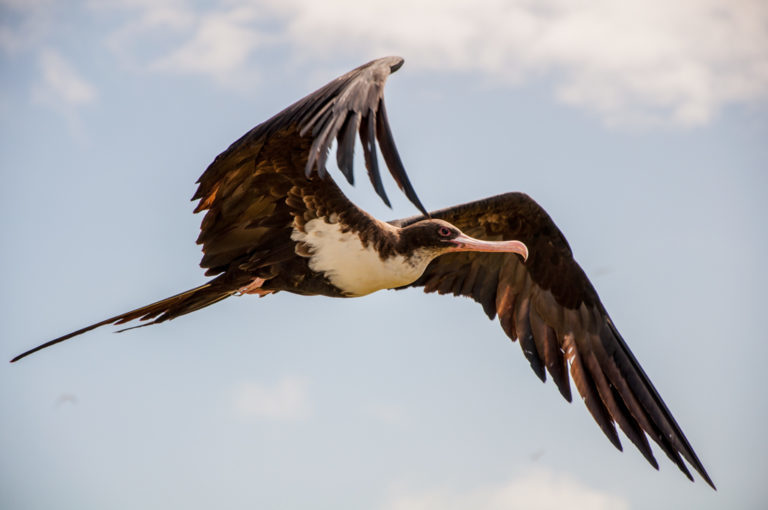
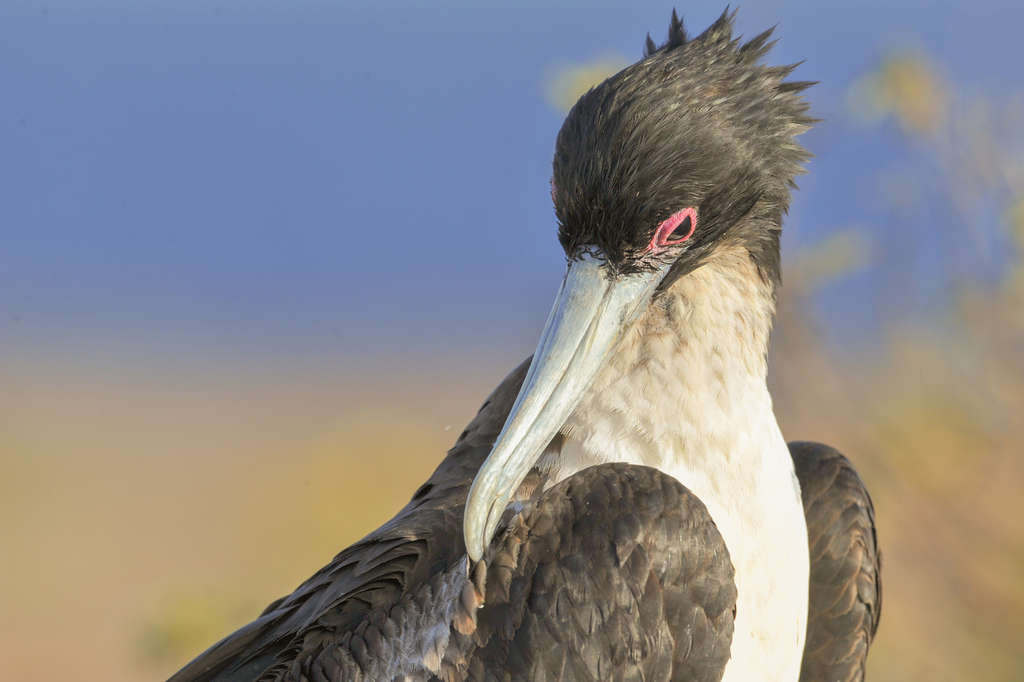
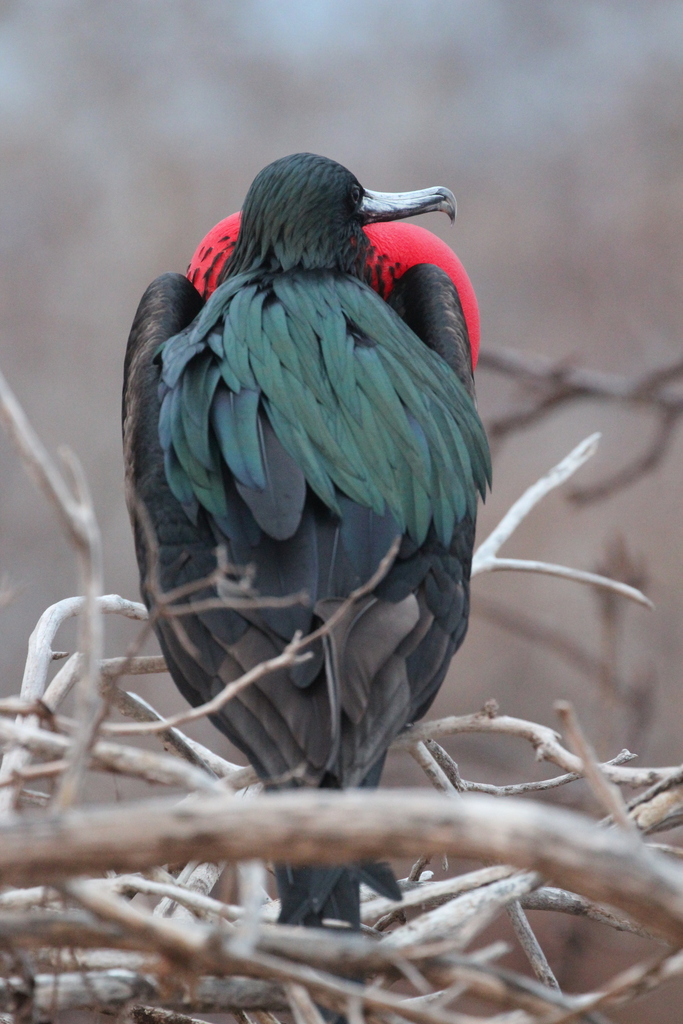
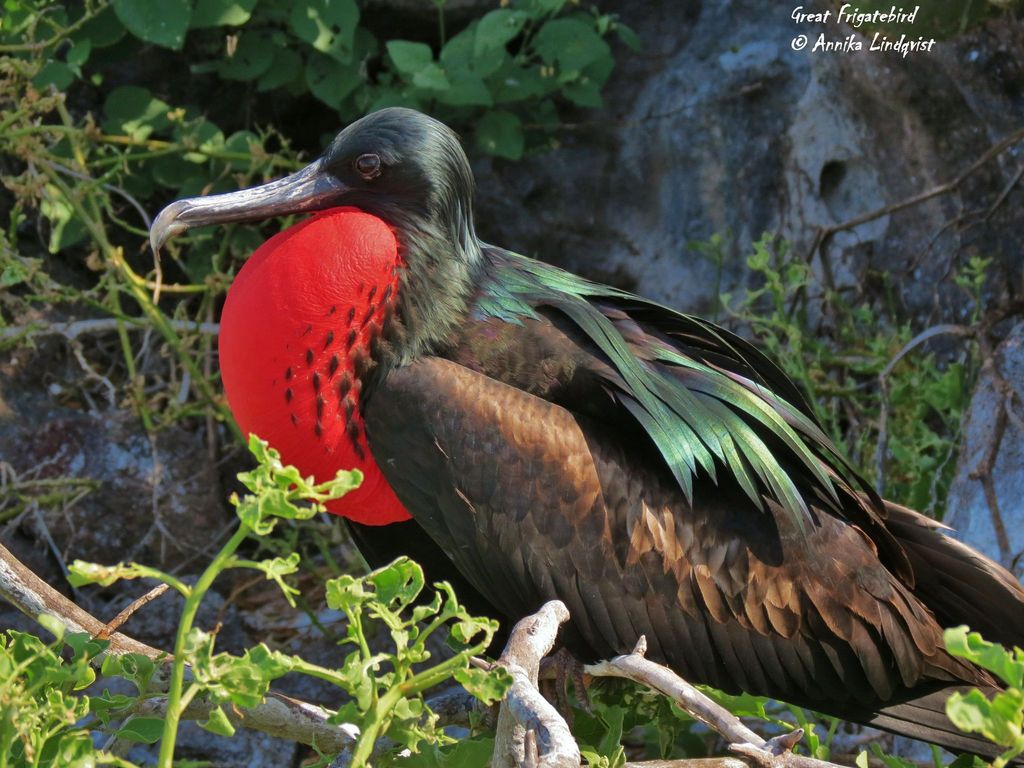
Photos show the species, not always the places on this page.
Length
About 85 to 105 cm (33 to 41 in) long, with a wingspan of about 205 to 230 cm (81 to 91 in).
Weight
Males about 1,000 to 1,450 g (2.2 to 3.2 lb). Females are larger, at about 1,215 to 1,590 g (2.7 to 3.5 lb). Animal Diversity Web gives 1 to 1.8 kg (2.2 to 4 lb) for the species.
Next to a person
A wingspan wider than a tall adult is tall. It weighs about as much as a small chicken.
What it eats
Mostly flying fish, plus other fish and squid snatched from the surface in flight. It sometimes takes seabird chicks and steals food from other seabirds. One study found theft supplied only about 5% of its food on average.
Around people
Calm, give space
How it lives
Great frigatebirds nest in colonies on islands, in low trees and shrubs. A female lays one egg, and it hatches after about 55 days. The chick fledges after 4 to 6 months, and parents keep feeding it for another 150 to 428 days, the longest post-fledging care of any bird. Pairs breed only every two years or less often. Wikipedia gives breeding ages of 8 to 11 years, while other sources give younger ages. Banded birds have lived at least 37 years, and one study recaptured a bird at least 44 years old. Frigatebirds do not land on the sea. Their feathers have little oil and they cannot take off from water.
Where it goes
Great frigatebirds travel widely over tropical seas. In a 2016 study, 14 birds on ocean trips stayed away for up to 10 days, on average 5.76 days, and flew up to 3,000 km. They flew at about 137 m on average and sometimes climbed to about 900 m. Other tracked birds have flown 873 km between Hawaiian islands and 4,400 km from the Mozambique Channel to the Maldives. There is no single migration route.
We only draw a journey on the map when scientists have tracked it or clearly documented it. For this animal we have not found one yet.
Populations
The species is pantropical, between about 25 degrees north and 25 degrees south, and is not found in the Caribbean. No global count is given in the sources I opened. Audubon notes declines since people settled many nesting islands. On Europa Island in the Mozambique Channel, 1,100 pairs bred in 2012. The South Atlantic subspecies, F. m. nicolli in Brazil, is Critically Endangered. There are five subspecies. IUCN assessed the species as Least Concern in 2020.
Meet it respectfully
Watch quietly from a distance and let the birds go about their day. Stay away from nesting trees, where males display with a red throat pouch. Never chase, touch, feed or bait a frigatebird, and never throw fish to draw it close. Keep boats back from nesting islands. Follow your guide.
Fun fact
Tap the bulb to light it up.
It has the largest wing area compared with body weight of any bird.
In a 2016 study, birds slept in flight, in naps of about 11 seconds. They slept about 3% of the time in the air and about 53% of the time on land.
Parents care for the chick for 150 to 428 days after it fledges, the longest post-fledging care of any bird.
Great frigatebird in the Ocean Atlas
Places we have researched where this animal is recorded. It is never guaranteed, and some places are for watching from the boat only.
Travel with usComing soonTrusted referralExploringOn pause, story onlyEthics pass
Country colour: pink where we travel, blue where we are exploring or refer, grey for story only.
 American Samoa
 Australia
 Brazil
 Chagos (British Indian Ocean Territory)
 Chile
Chile Christmas Island
 Cocos (Keeling) Islands
 Colombia
 Cook Islands
 Costa Rica
 Ecuador
 Fiji
Fiji France
 French Polynesia
 Guam
Guam Indonesia
 Japan
Japan Kenya
Kenya Kiribati
 Madagascar
 Malaysia
 Marshall Islands
 Mexico
 Micronesia (FSM)
 Mozambique
 New Caledonia
 New Zealand
 Niue
Niue Norfolk Island
 Northern Mariana Islands
 Palau
Palau Papua New Guinea
 Philippines
 Pitcairn Islands
 Samoa
Samoa Seychelles
 Solomon Islands
 South Africa
 Taiwan
 Timor-Leste
 Tonga
Tonga United States
 Vanuatu
 Wallis and Futuna
Sources for this page
- Wikipedia, Great frigatebird, 2026
- Wikipedia, Frigatebird, 2026
- Animal Diversity Web, Fregata minor, 2026
- Birds of the World, Great frigatebird, 2026
- Rattenborg et al., 2016, Nature Communications
- Western Indian Ocean frigatebird study, PLoS One, 2014
- GBIF, IUCN Red List category, 2026
Facts checked 5 October 2026. Photos: Unsplash licence, or Creative Commons as shown on each photo.
Work in ocean travel?
We are always happy to hear from exceptional local operators, accommodation, conservation organisations and destination experts. If your work fits responsible, small-group ocean travel, we would love to learn more.
Partner with Ocean Calling7-day freediving course in Coron, Palawan
CHF 1,480