
Silky shark
Carcharhinus falciformis
Silky sharks live where tuna and open ocean meet. They are sleek predators that stay mostly near the surface and can travel thousands of kilometres across international waters.
Vulnerable (IUCN, 2017) means it is at high risk of extinction in the wild.
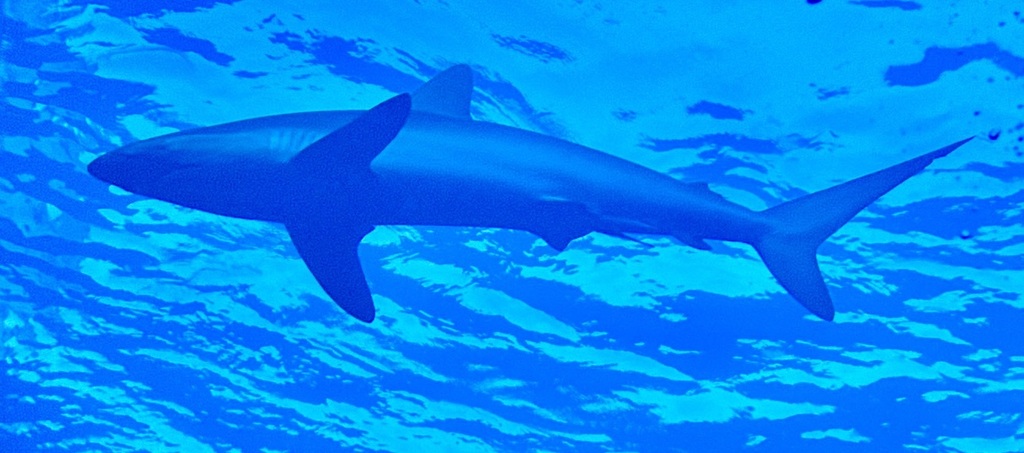
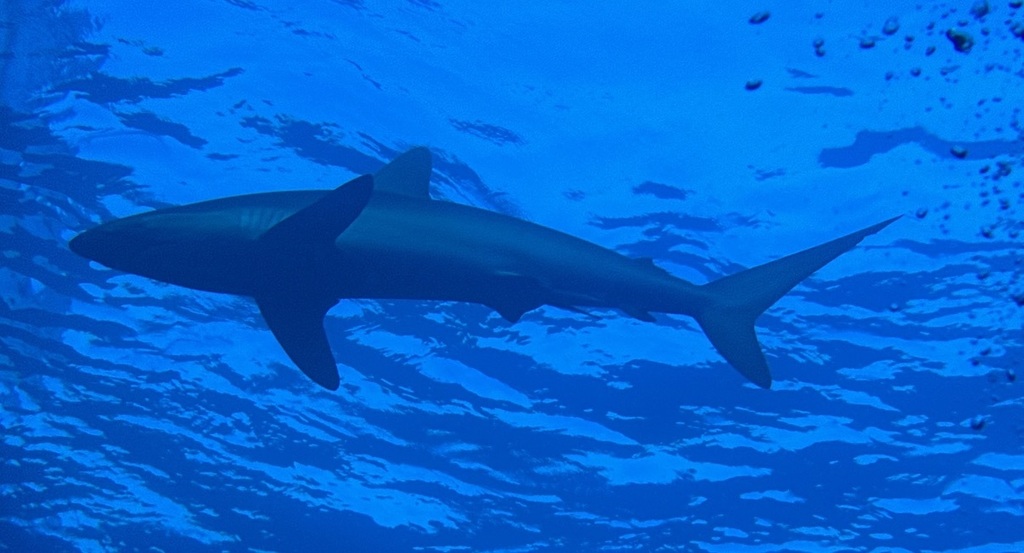
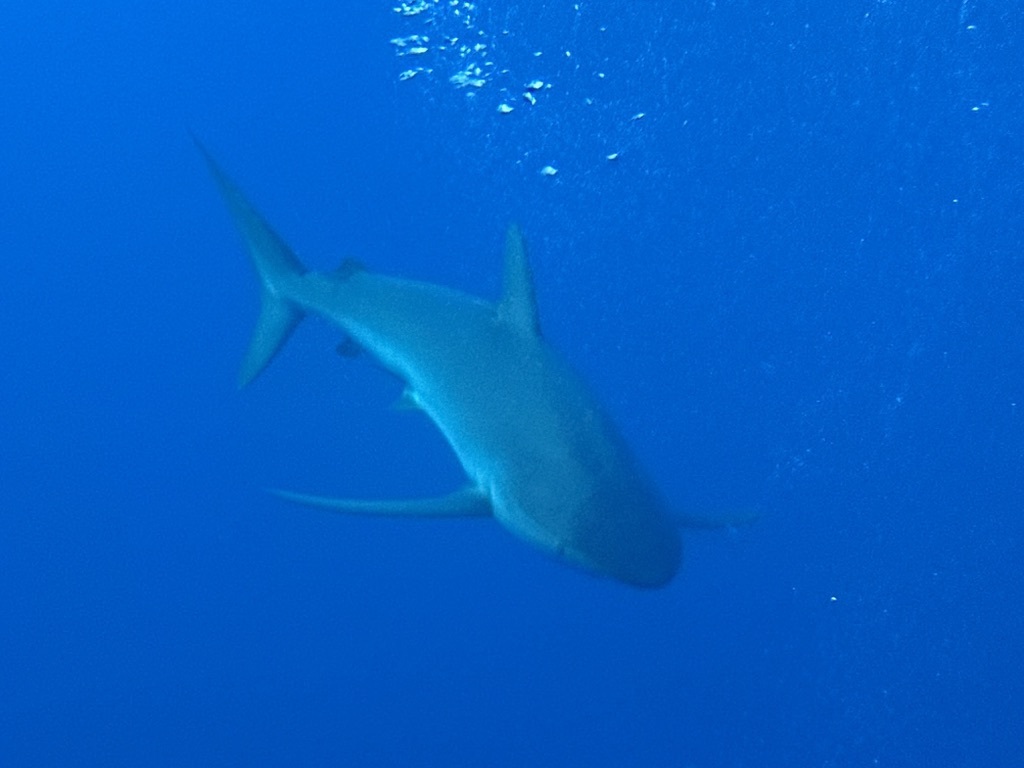
Photos show the species, not always the places on this page.
Length
Commonly about 2.5 m (8.2 ft); largest about 3.3 to 3.5 m (10.8 to 11.5 ft)
Weight
Typical adult weight not reliably measured; heaviest published about 346 kg (763 lb)
Next to a person
About one-and-a-half times as long as a person
What it eats
Mainly bony fish such as tuna and mackerel, plus squid and some crabs.
Around people
Defensive if pressured
How it lives
The silky shark lives in the open ocean, often near the edges of continental and island shelves, and is frequently found with schools of tuna. It is very sensitive to sound, possibly to find other animals feeding. Females give birth to live pups, commonly 2 to 14, after about 11 to 12 months, usually every other year.
Where it goes
Silky sharks are strong travellers. Young sharks can stay near floating objects for a while, but they also spread across whole ocean basins. Tagged sharks spent most of their time near the surface, with some deep dives. One shark tagged in the Galápagos travelled more than 27,000 km in 546 days, a record, not a normal route.
We only draw a journey on the map when scientists have tracked it or clearly documented it. For this animal we have not found one yet.
Populations
Silky sharks of the Atlantic and the Indo-Pacific are genetically quite separate, with finer differences within each ocean, such as several stocks in the eastern Pacific. How they use tuna schools and seamounts differs by region. There are no subspecies.
Meet it respectfully
Silky sharks are fast and curious. Stay calm and in a group, keep the shark in view and do not splash at the surface. Never feed, bait, chase or block them, and never carry speared fish. If a shark raises its head, arches its back and lowers its tail, it is giving a threat display: move slowly away.
Fun fact
Tap the bulb to light it up.
Its name comes from its skin: tiny overlapping scales give it a smooth, silky look.
In the eastern Pacific it is called the net-eater shark, for tearing through tuna nets.
Tracked silky sharks in the western Indian Ocean spent about three quarters of their time in the top 20 m.
Its name comes from its skin. Tiny, tightly packed, overlapping scales called denticles give it a smooth, silky look.
Source: Florida Museum of Natural History, Carcharhinus falciformis profile
In the eastern Pacific it has a nickname: the net-eater shark. It earned it by tearing through tuna seine nets.
Source: Florida Museum of Natural History, Carcharhinus falciformis profile
Silky shark in the Ocean Atlas
Places we have researched where this animal is recorded. It is never guaranteed, and some places are for watching from the boat only.
Travel with usComing soonTrusted referralExploringOn pause, story onlyEthics pass
Country colour: pink where we travel, blue where we are exploring or refer, grey for story only.
 Angola
 Australia
 The Bahamas
 Brazil
 Chagos (British Indian Ocean Territory)
 Colombia
 Comoros
 Costa Rica
 Côte d'Ivoire
 Denmark
 Ecuador
 Egypt
Egypt Faroe Islands
 Finland
 France
 French Polynesia
 Gabon
Gabon Ghana
Ghana Guinea
 India
India Indonesia
 Japan
Japan Kenya
Kenya Madagascar
 Malaysia
 Mauritius
 Mayotte
 Mexico
 Mozambique
 New Caledonia
 Norway
 Oman
Oman Papua New Guinea
 Philippines
 Portugal
 Saudi Arabia
 Seychelles
 Singapore
 Somalia
 Spain
Spain Sri Lanka
 Sudan
Sudan Sweden
 Tanzania
 Tokelau
 Trinidad and Tobago
 United Kingdom
 United States
Sources for this page
- Florida Museum of Natural History, 2026
- FishBase, 2017
- PLOS ONE
- Salinas-de-León et al., 2024, Journal of Fish Biology
- Filmalter et al., 2021, ICES Journal of Marine Science
- IOTC, 2025
Facts checked 26 September 2026. Photos: Unsplash licence, or Creative Commons as shown on each photo.
Work in ocean travel?
We are always happy to hear from exceptional local operators, accommodation, conservation organisations and destination experts. If your work fits responsible, small-group ocean travel, we would love to learn more.
Partner with Ocean CallingNew: mobula rays in La Ventana, May 2027
CHF 2,720