
Whitespotted eagle ray
Aetobatus narinari
Whitespotted eagle rays glide over Caribbean reefs like underwater birds. We give them space and let them choose the distance.
Endangered (IUCN, 2020) means it is at very high risk of extinction in the wild.
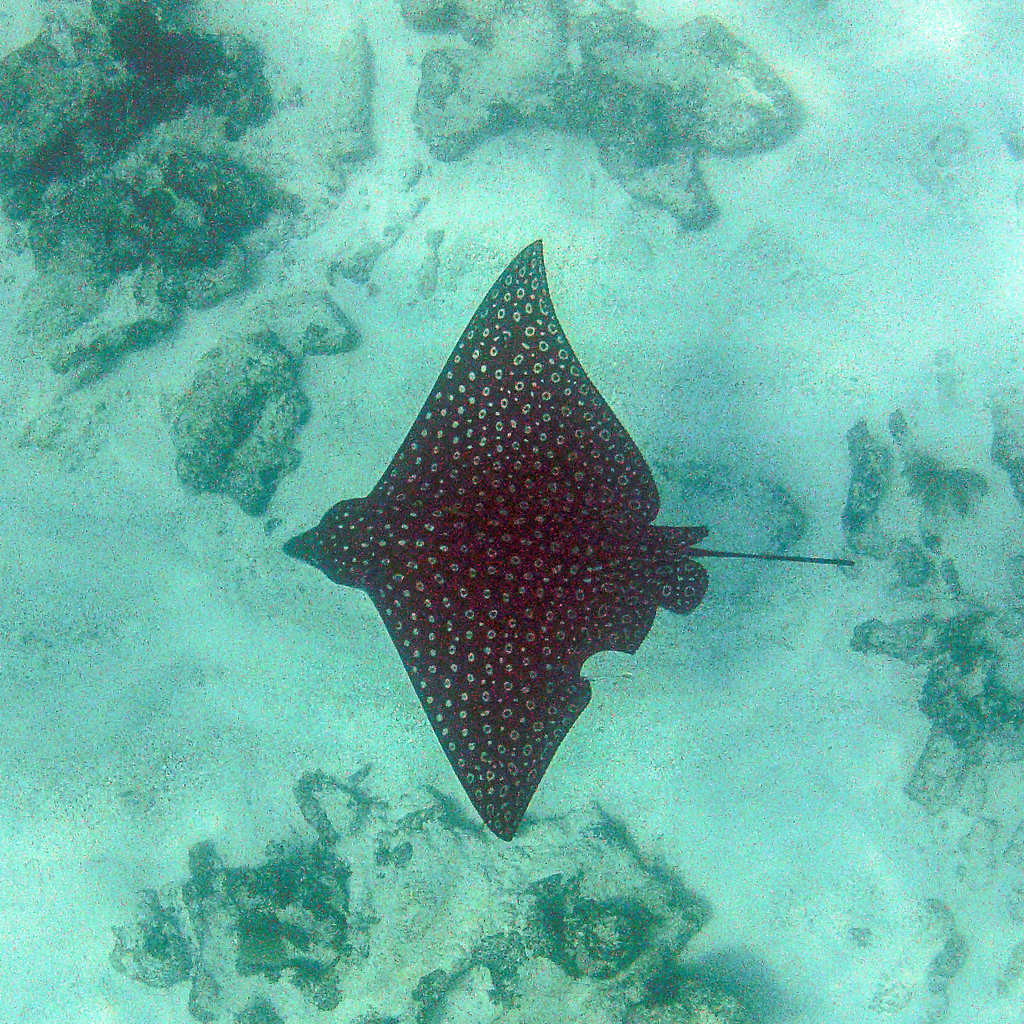
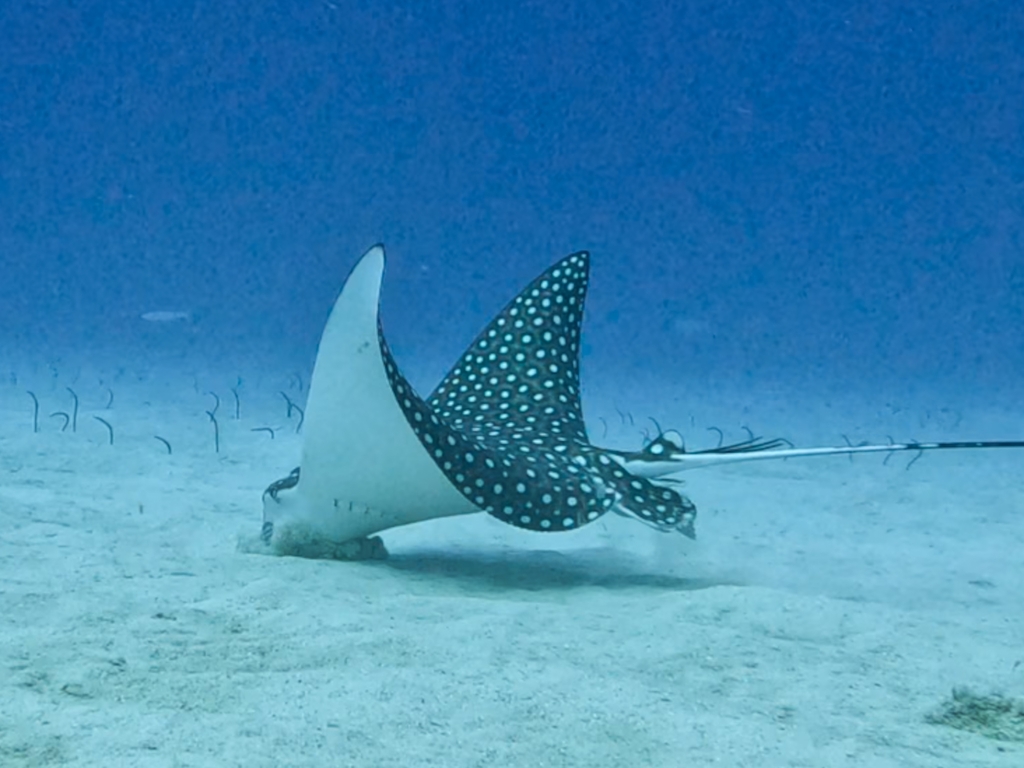
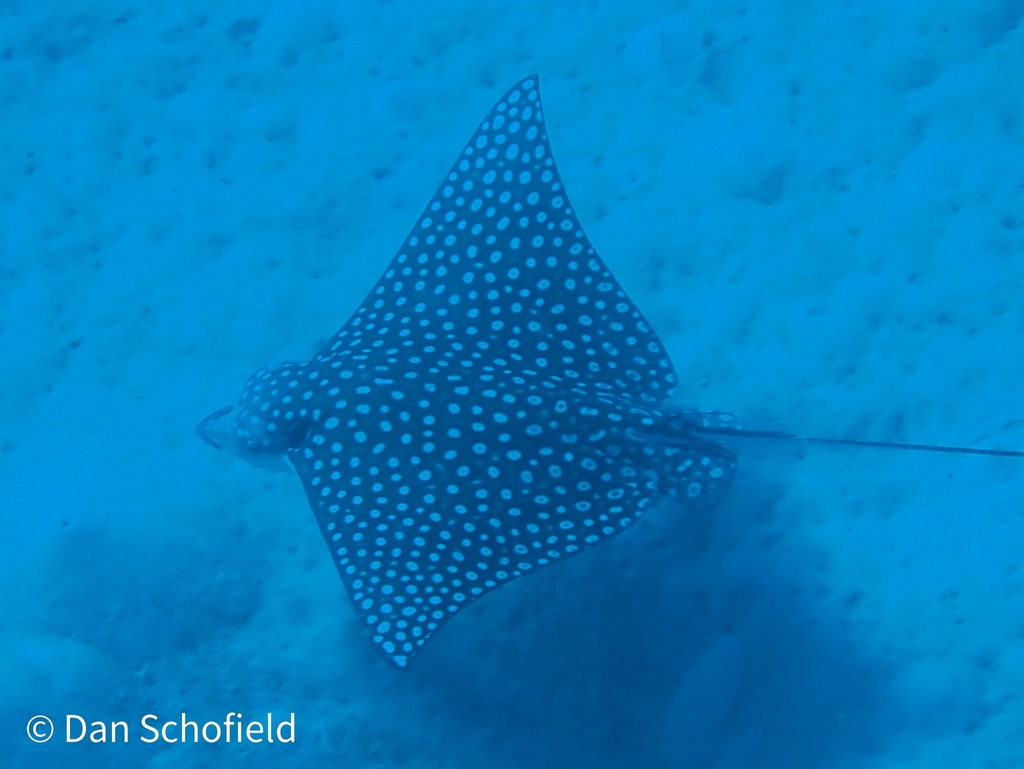
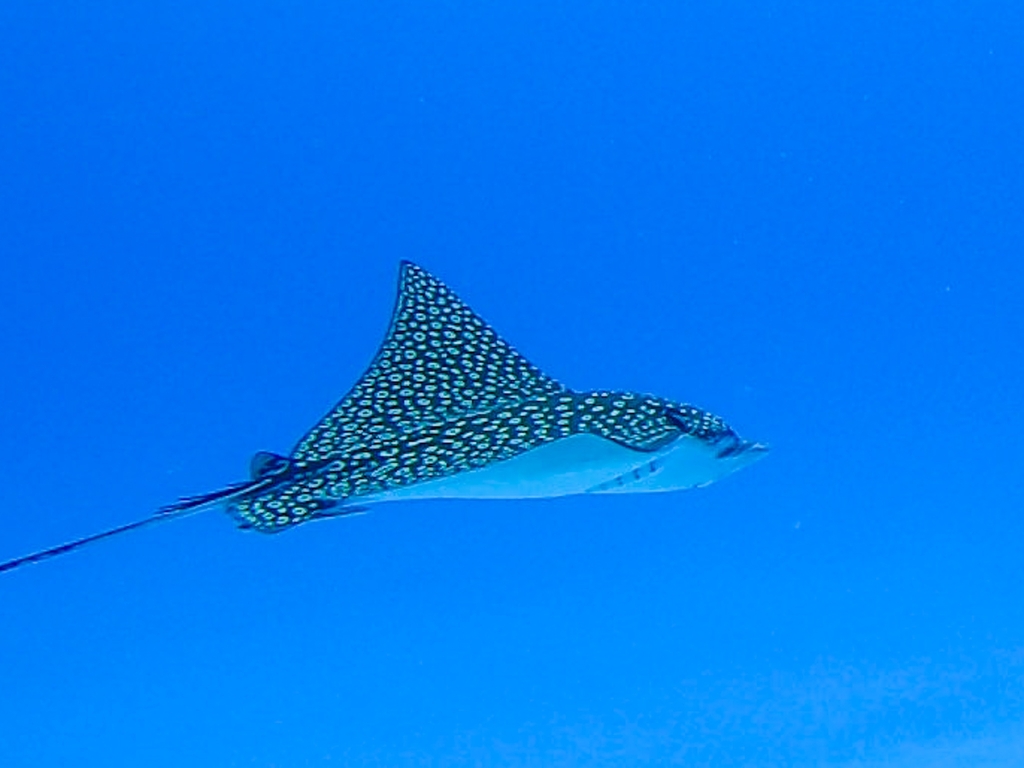
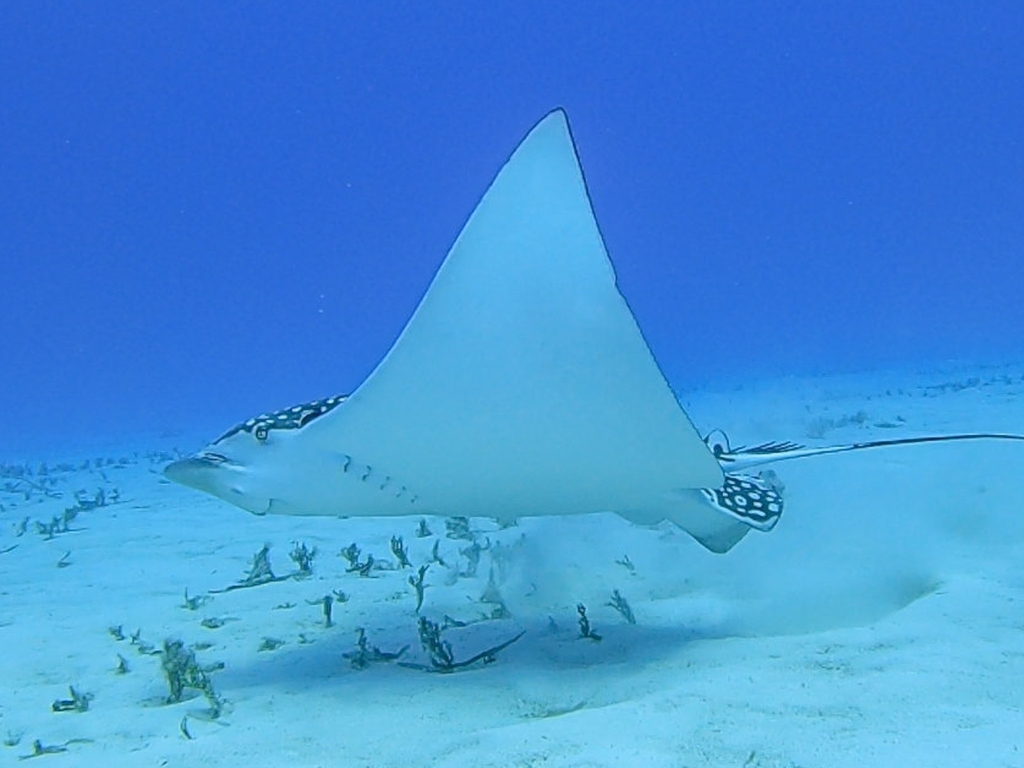
Photos show the species, not always the places on this page.
Length
Disc usually about 1.4 m (4.6 ft) across; largest recorded 2.3 to 3 m (7.5 to 9.8 ft) across, depending on source. With the long tail, total length can be over 5 m (16.4 ft)
Weight
Typical weight not reliably measured; largest published about 227 to 230 kg (500 to 507 lb)
Next to a person
The biggest are wider than a tall adult is tall
What it eats
Clams and other shellfish, shrimps, crabs, octopus, worms and small fish.
Around people
Defensive if pressured
How it lives
This eagle ray lives in warm, shallow bays, estuaries and reefs of the western Atlantic. It crushes clams and other hard prey with plate-like teeth. It often swims near the surface, sometimes leaps right out of the water, and can form schools. Females give birth to live young, up to four pups.
Where it goes
Some rays stay, some travel. In Florida, 54 rays were tracked from 2016 to 2018. Rays tagged in the Indian River Lagoon mostly stayed there, while Sarasota Bay rays moved along the Gulf coast with the seasons and preferred warm water. One Sarasota male was later heard off the Yucatán coast of Mexico.
Populations
Until about 2010 all spotted eagle rays were seen as one worldwide species. Now this name is kept for the rays of the western Atlantic, from the United States to Brazil. Genes show Florida and Mexico rays are a bit different, with Cuba linking both.
Meet it respectfully
Give it several metres and stay out of its escape path. Stay low and calm, and never touch, chase or corner it. Its tail has one or more venomous spines that can cause serious injury if the ray is stepped on, grabbed or cornered. Boats should go slowly in shallow bays. In Florida state and federal waters it is illegal to take this ray.
Fun fact
Tap the bulb to light it up.
Each ray has its own white spot pattern, so scientists can tell individuals apart from photos.
It crushes clams and snails with broad, flat tooth plates.
Spotted eagle rays in the Indo-Pacific are now a different species, Aetobatus ocellatus.
A male eagle ray tagged in Sarasota Bay, Florida, in June 2016 was picked up three years later, in July 2019, in the shallow waters off the Yucatán coast of Mexico.
Source: DeGroot et al., 2021, Marine Biology, migration of whitespotted eagle rays along Florida's coasts
Around South Caicos, 165 eagle rays were told apart by their spot patterns. One ray was seen again 1,640 days after the first photo, more than four years later.
Source: Flowers et al., 2017, Journal of Fish Biology, site affinity of eagle rays at South Caicos
Tags on rays in Bermuda and Florida showed they spend about 83% of their time in the top 10 m of water.
Source: Brewster et al., 2020, Journal of Fish Biology, depth use of eagle rays in Bermuda and Florida
Follow its journey
Watch it travel. Every line comes from satellite tracking or documented research, and the source is named.
StartEndJourney (the line joins documented areas; real paths vary)
Whitespotted eagle ray in the Ocean Atlas
Places we have researched where this animal is recorded. It is never guaranteed, and some places are for watching from the boat only.
Travel with usComing soonTrusted referralExploringOn pause, story onlyEthics pass
Country colour: pink where we travel, blue where we are exploring or refer, grey for story only.
 Angola
 Antigua and Barbuda
 Aruba
Aruba Australia
 The Bahamas
 Belize
 Benin
Benin Bermuda
 Brazil
 British Virgin Islands
 Cameroon
 Caribbean Netherlands
 Cayman Islands
 Colombia
 Côte d'Ivoire
 Cuba
Cuba Curaçao
 Democratic Republic of the Congo
 Dominica
 Dominican Republic
 Ecuador
 Egypt
Egypt Equatorial Guinea
 French Polynesia
 Gabon
Gabon Ghana
Ghana Guadeloupe
 Guinea
 Guinea-Bissau
 Honduras
 Jamaica
 Japan
Japan Liberia
 Maldives
 Marshall Islands
 Martinique
 Mexico
 Mozambique
 New Caledonia
 Nicaragua
 Nigeria
 Panama
 Philippines
 Puerto Rico
 Republic of the Congo
 Saint Lucia
 Saint Martin
 Senegal
 Seychelles
 Sierra Leone
 Sint Maarten
 South Africa
 Togo
Togo Trinidad and Tobago
 Turks and Caicos Islands
 United States
 US Virgin Islands
 Wallis and Futuna
Sources for this page
- DeGroot et al., 2021, Marine Biology, migration of whitespotted eagle rays along Florida's coasts
- Florida Fish and Wildlife Conservation Commission, Spotted eagle ray
- Sellas et al., 2015, Journal of Heredity, population structure and seasonal migration of the spotted eagle ray
- Flowers et al., 2017, Journal of Fish Biology, site affinity of eagle rays at South Caicos
- Brewster et al., 2020, Journal of Fish Biology, depth use of eagle rays in Bermuda and Florida
- iNaturalist research-grade records, Aetobatus narinari, checked 25 Sep 2026
- FishBase, 2025, Aetobatus narinari
- Dulvy et al., 2021, IUCN Red List, Aetobatus narinari (Endangered)
Facts checked 26 September 2026. Photos: Unsplash licence, or Creative Commons as shown on each photo.
Work in ocean travel?
We are always happy to hear from exceptional local operators, accommodation, conservation organisations and destination experts. If your work fits responsible, small-group ocean travel, we would love to learn more.
Partner with Ocean CallingNot sure where to go? Get your Ocean Match
from CHF 19