
Great cormorant
Phalacrocorax carbo
A dark shape drying its wings on a post or a rock. Every sighting is a quiet gift of the day, never a promise.
Least Concern (IUCN, 2018) means it is not at high risk of extinction. The species is widespread and numerous, and in parts of Europe it has increased since it was protected.
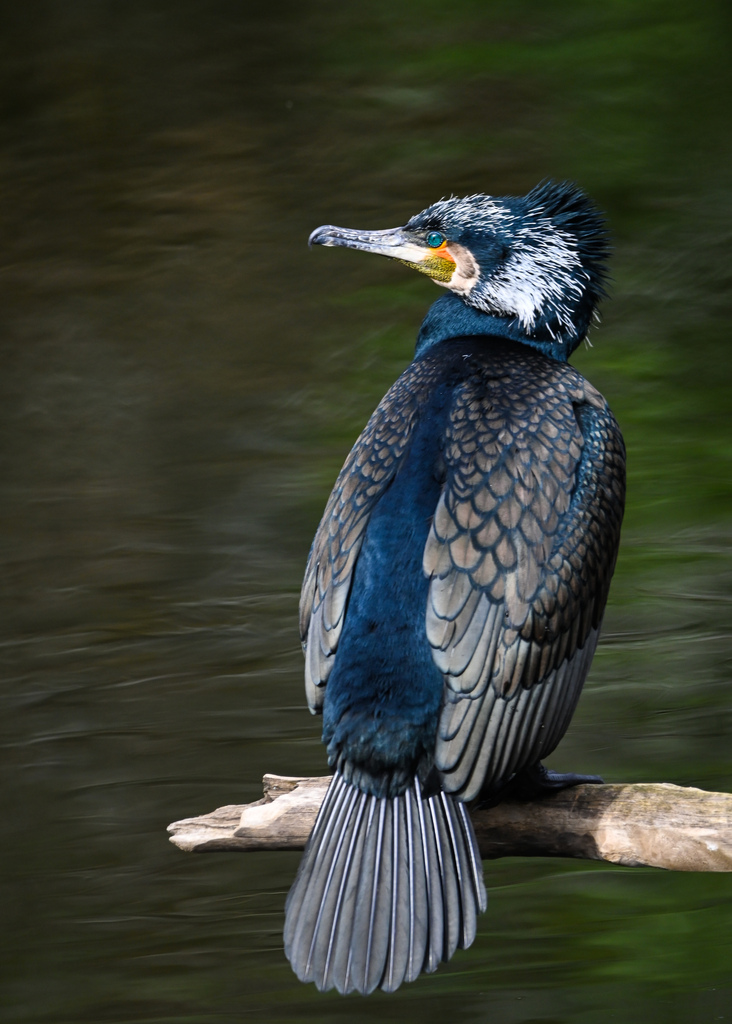
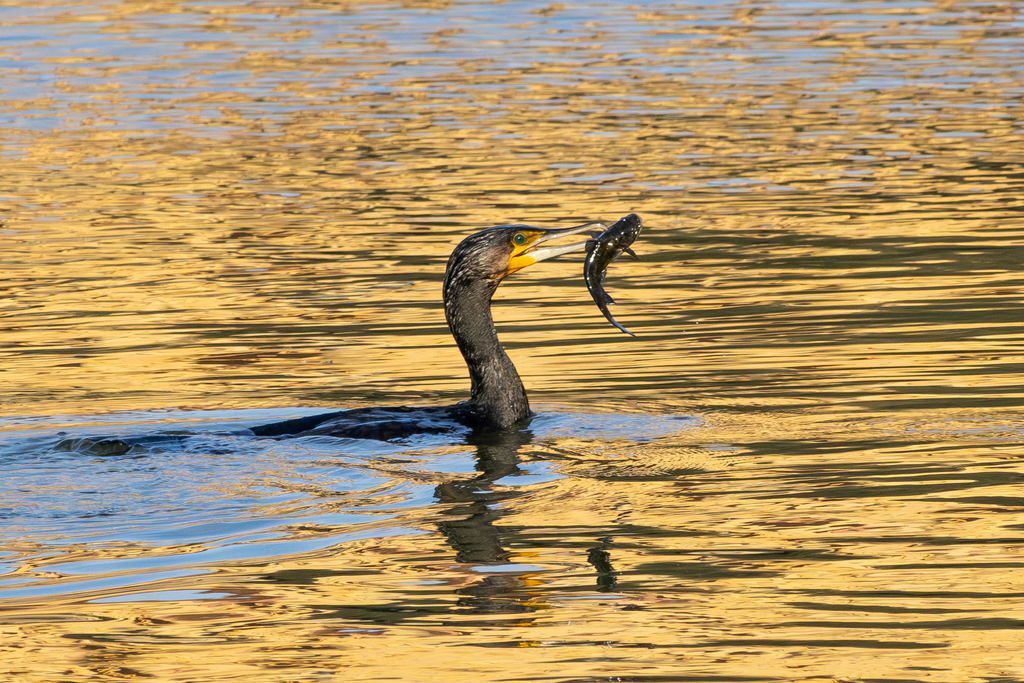
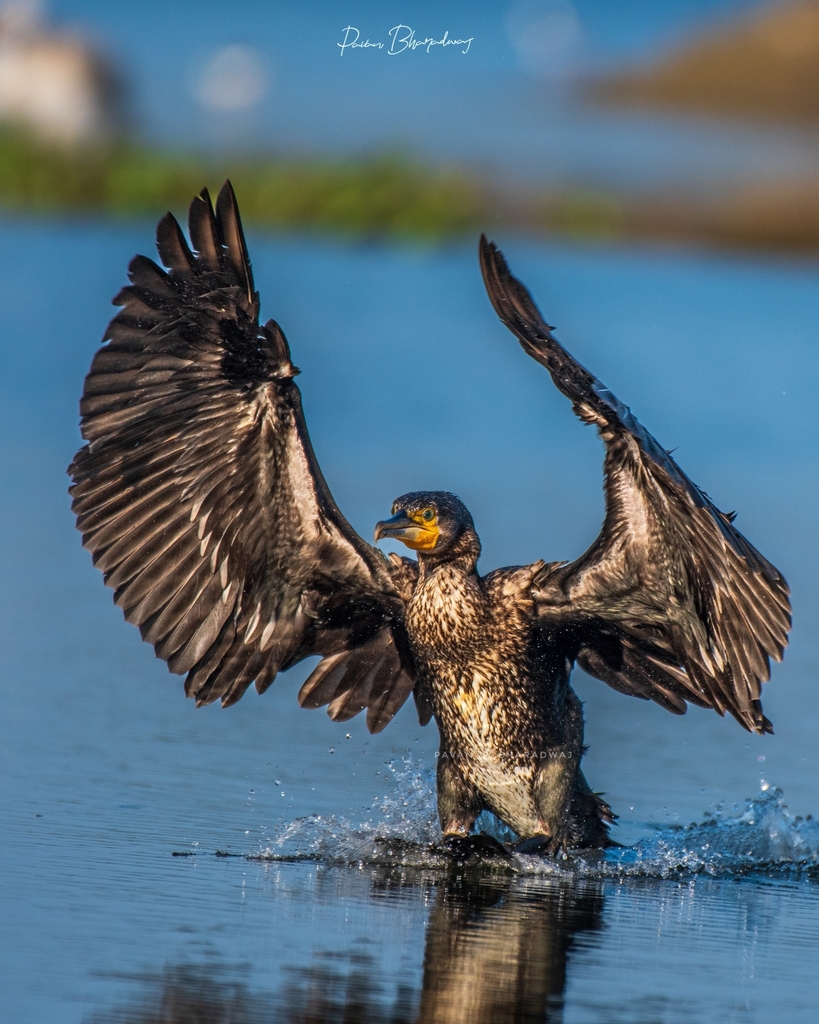
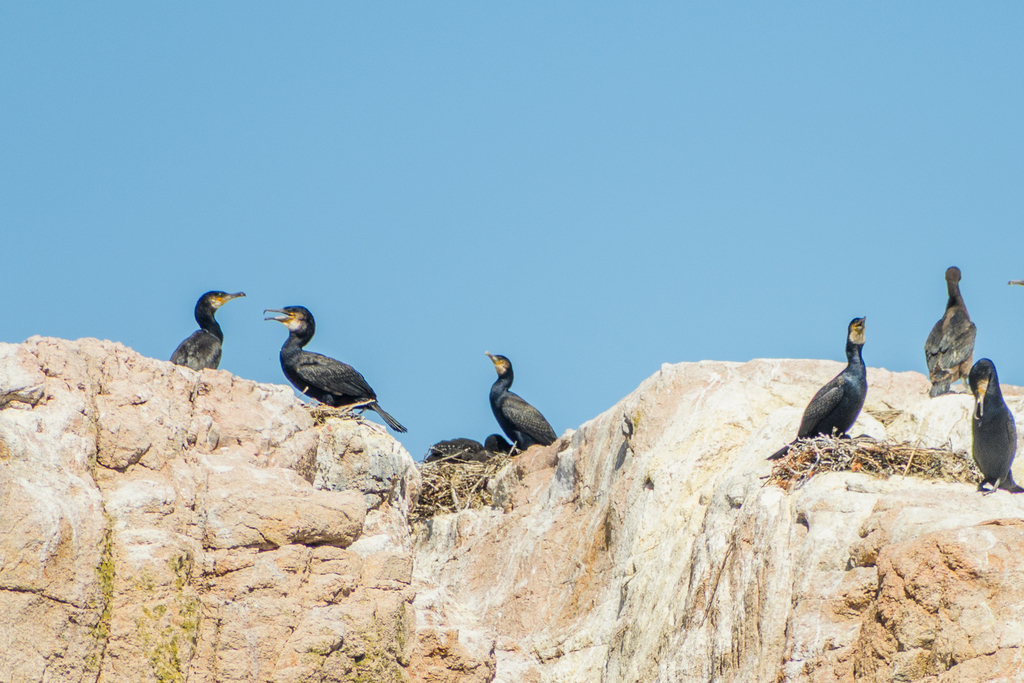
Photos show the species, not always the places on this page.
Length
About 70 to 102 cm (28 to 40 in) long, with a wingspan of about 121 to 160 cm (48 to 63 in). Size varies with subspecies and sex.
Weight
About 1.5 to 5.3 kg (3.3 to 11.7 lb) across the species; Audubon gives 2.2 to 4 kg (4.8 to 8.8 lb). Males are larger than females, and the Atlantic subspecies is about 10% larger than the continental one. A typical UK bird weighs about 2.3 kg (5.1 lb).
Next to a person
A body about as long as a child is tall, with a wingspan close to a tall child's outstretched arms. A typical bird weighs about as much as two bags of sugar.
What it eats
Mostly fish, caught by diving and pushing with its feet. Most dives are shallow, and the deepest reach about 9 m (30 ft). BirdLife also lists amphibians, crustaceans and nestling birds. Most feeding trips stay within 10 km of the colony, and some reach 20 to 25 km.
Around people
Calm, give space
How it lives
Great cormorants nest in colonies, in trees, on cliff ledges or on rocky islands. A pair lays 3 to 5 eggs, and they hatch after about 28 to 31 days. Chicks fledge at about 48 to 52 days. Birds usually first breed at about 3 to 5 years. A typical bird that reaches breeding age lives about 11 years more, and the oldest ringed bird in the UK reached 21 years 6 months.
Where it goes
Some populations stay put and others migrate. In Britain, birds are resident, and many more arrive from continental Europe in winter. In northern Europe, birds show chain migration: northern birds winter in areas that southern breeding birds leave for places further south.
We only draw a journey on the map when scientists have tracked it or clearly documented it. For this animal we have not found one yet.
Populations
BirdLife gives a global estimate of 1.4 to 2.1 million birds, and 828,000 to 1,030,000 mature individuals in Europe. In the UK, about 8,900 pairs bred in 1998 to 2002, and about 65,000 birds wintered in 2012 to 2017. The UK winter count rose 46% between 1998 and 2023. Numbers have also risen along the western Mediterranean coast between 1957 and 2024. Six subspecies are recognised. IUCN assessed the species as Least Concern in 2018.
Meet it respectfully
Watch from a distance and let the bird dry its wings in peace. Keep well back from nesting colonies and roosts. Never chase, touch, feed or bait it, and never throw fish to bring it closer. Keep boats clear of groups resting on rocks and posts. Follow your guide.
Fun fact
Tap the bulb to light it up.
Its feathers are not fully waterproof. Wet feathers make it less buoyant for diving, and it often stands with its wings held out to dry.
Research suggests great cormorants hear well underwater, which may make up for limited underwater vision.
In Britain, cormorants began breeding at inland freshwater sites in 1981, after living mostly on the coast.
Great cormorant in the Ocean Atlas
Places we have researched where this animal is recorded. It is never guaranteed, and some places are for watching from the boat only.
Travel with usComing soonTrusted referralExploringOn pause, story onlyEthics pass
Country colour: pink where we travel, blue where we are exploring or refer, grey for story only.
 Albania
 Algeria
 Angola
 Australia
 Bahrain
 Bangladesh
 Belgium
 Bermuda
 Cambodia
 Canada
 China
 Croatia
 Cyprus
 Democratic Republic of the Congo
 Denmark
 Egypt
 Estonia
 Faroe Islands
 Finland
 France
 Gambia
 Georgia
 Germany
 Gibraltar
 Greece
 Greenland
 Guinea-Bissau
 Hong Kong
 Iceland
 India
 Iran
 Iraq
 Ireland
 Israel
 Italy
 Japan
 Jordan
 Kenya
 Kuwait
 Latvia
 Lebanon
 Libya
 Lithuania
 Macau
 Malaysia
 Malta
 Mauritania
 Monaco
 Montenegro
 Morocco
 Mozambique
 Myanmar
 Namibia
 Netherlands
 New Caledonia
 New Zealand
 Norfolk Island
 Norway
 Oman
 Pakistan
 Palestine
 Papua New Guinea
 Philippines
 Poland
 Portugal
 Qatar
 Romania
 Russia
 Saudi Arabia
 Senegal
 Singapore
 Slovenia
 Solomon Islands
 South Africa
 South Korea
 Spain
 Sri Lanka
 Sudan
 Sweden
 Taiwan
 Tanzania
 Thailand
 Tunisia
 Türkiye
 Ukraine
 United Arab Emirates
 United Kingdom
 United States
 Vietnam
 Western Sahara
Sources for this page
- Wikipedia, Great cormorant, 2026
- BTO BirdFacts, Cormorant, 2026
- RSPB, Cormorant, 2026
- BirdLife International, Seabird of the month, 2022
- Audubon, Great cormorant, 2026
- Coastal bird community recovery in three European seas, 2025
- GBIF, IUCN Red List category, 2026
Facts checked 5 October 2026. Photos: Unsplash licence, or Creative Commons as shown on each photo.
Work in ocean travel?
We are always happy to hear from exceptional local operators, accommodation, conservation organisations and destination experts. If your work fits responsible, small-group ocean travel, we would love to learn more.
Partner with Ocean Calling5-day freediving course in Bali
CHF 1,180