
Leatherback turtle
Dermochelys coriacea
The largest sea turtle on Earth is a soft-shelled, deep-diving jellyfish hunter that can cross whole oceans between tropical nesting beaches and distant feeding grounds.
Vulnerable (IUCN, 2013) means it is at high risk of extinction in the wild. Several populations, for example in the East and West Pacific, are Critically Endangered.

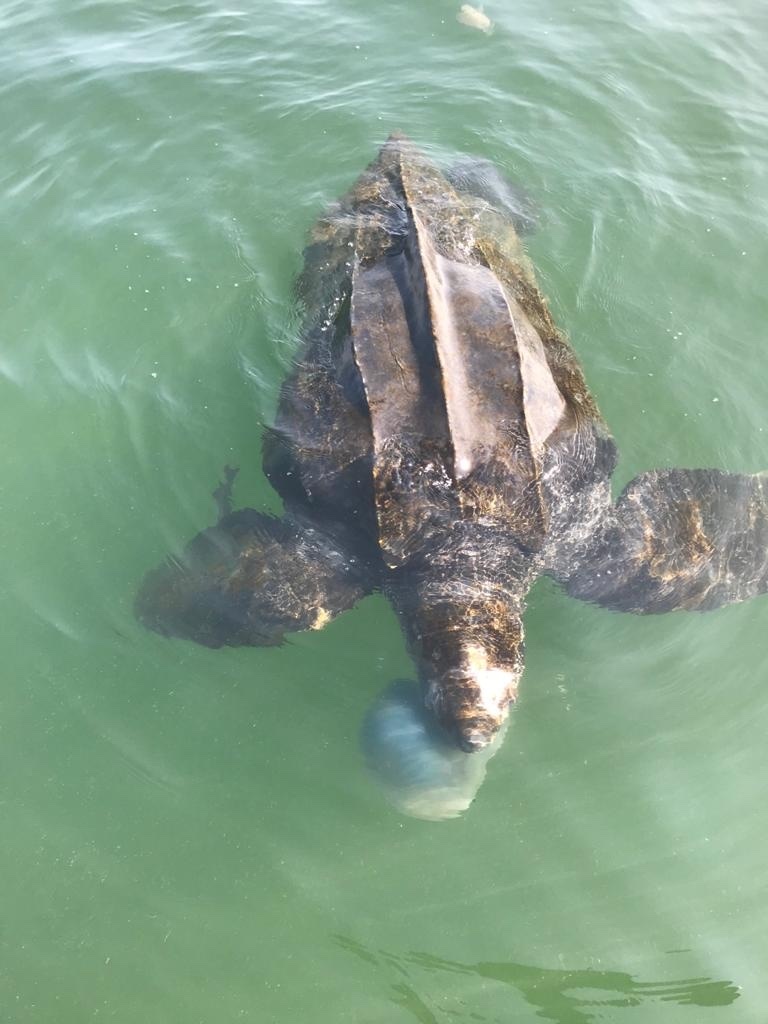
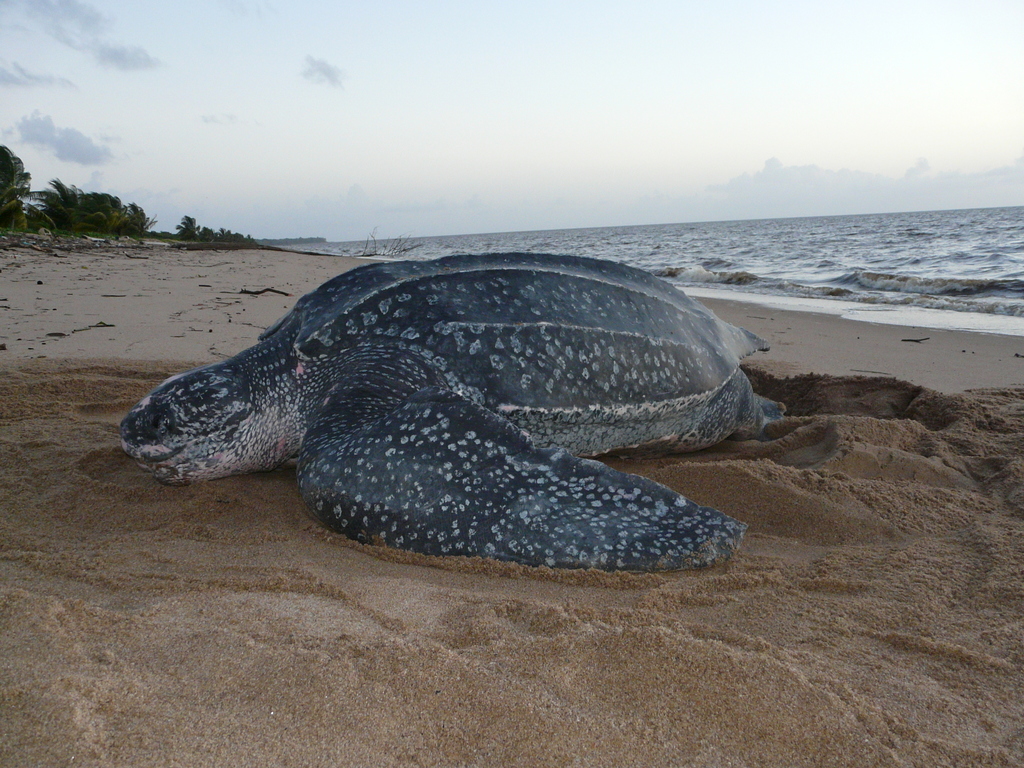
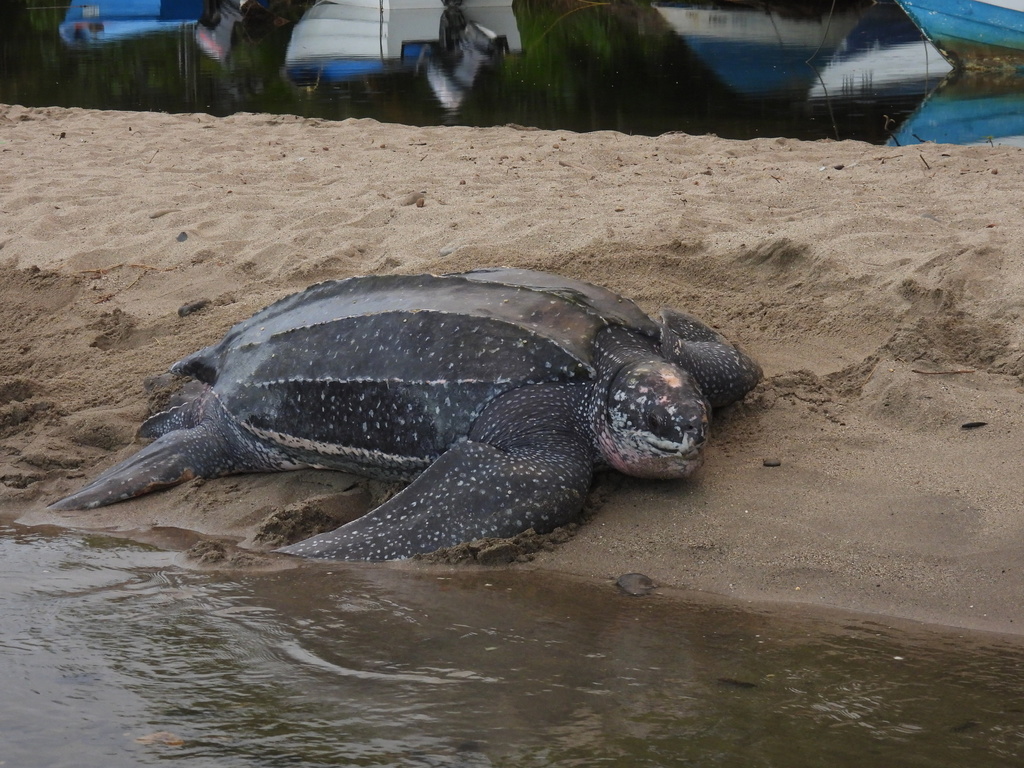
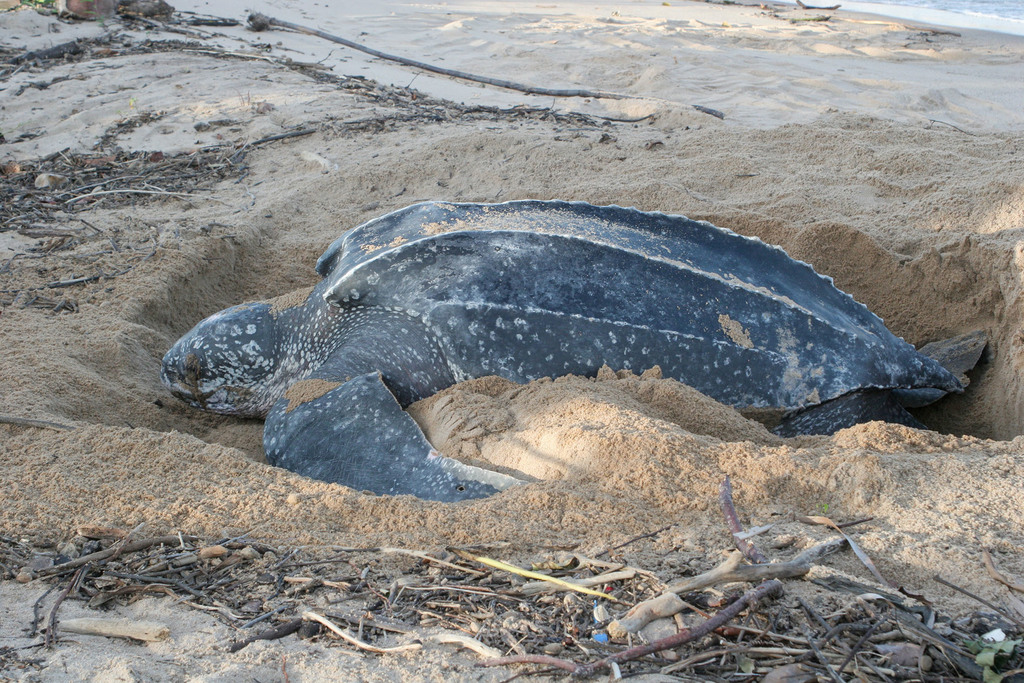
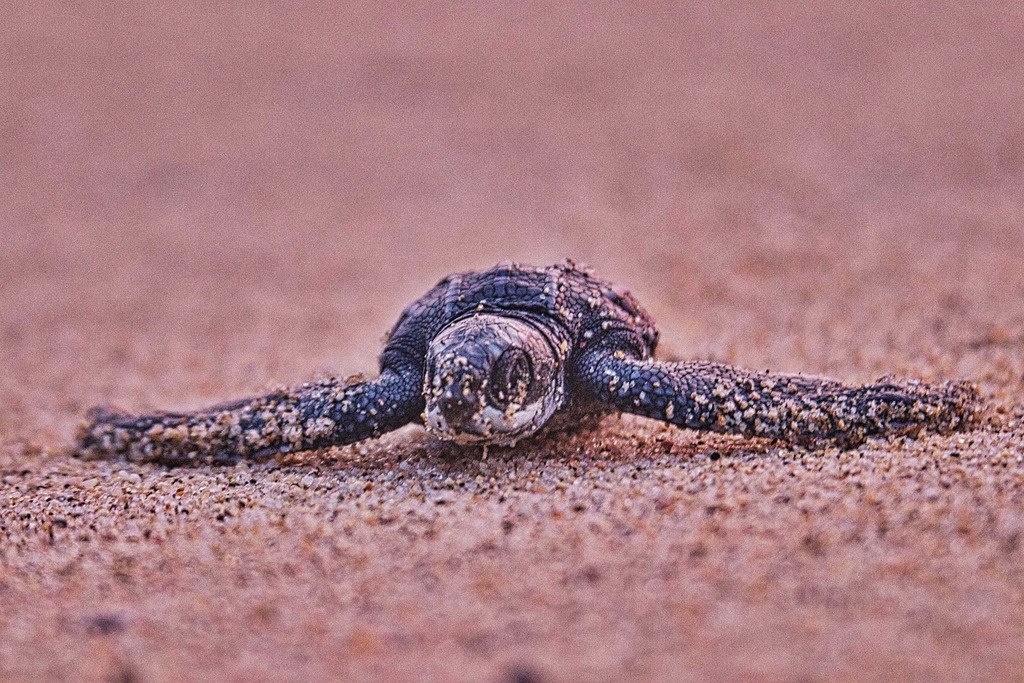
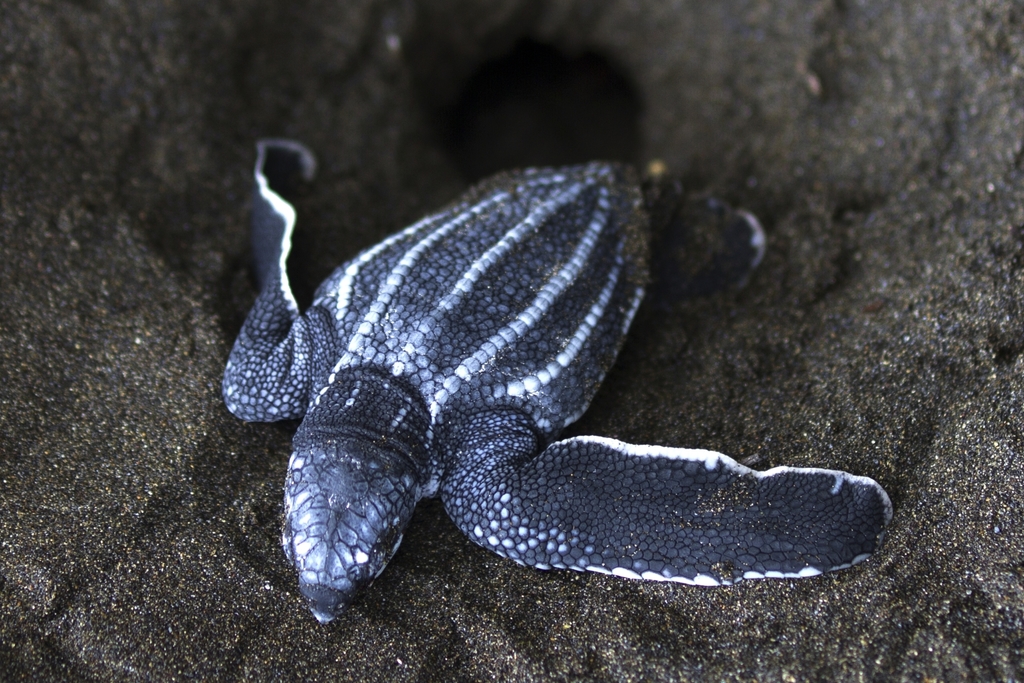
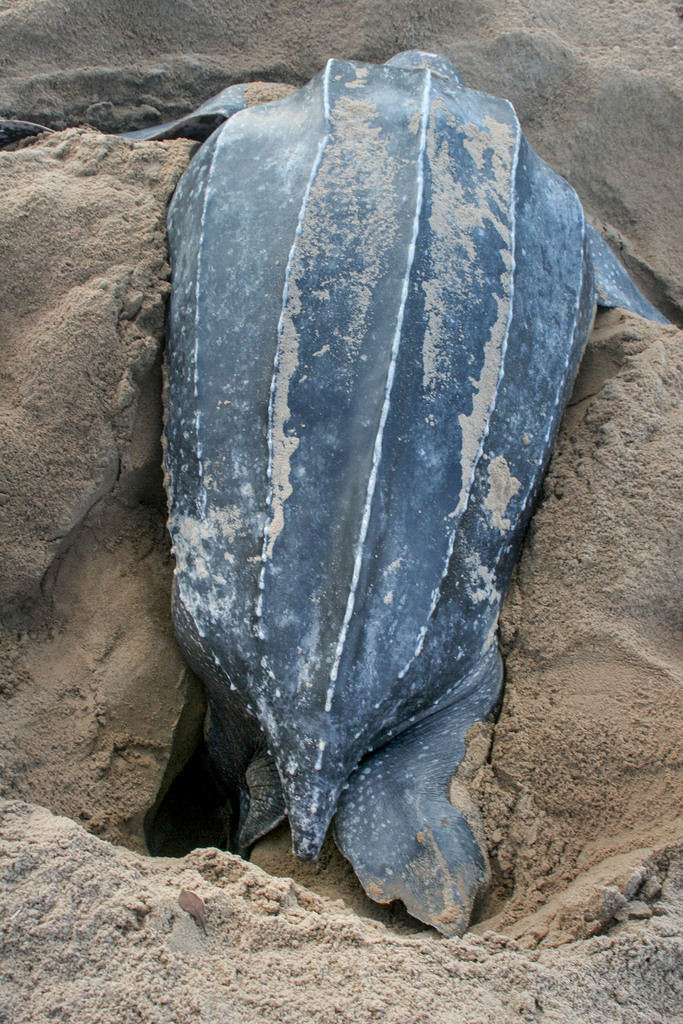
Photos show the species, not always the places on this page.
Length
Shell usually about 1.5 to 1.8 m (5 to 6 ft) long; some are larger
Weight
Usually about 340 to 454 kg (750 to 1,000 lb); some are larger
Next to a person
Bigger than a person lying down
What it eats
Mainly jellyfish, salps and other soft, jelly-like animals.
Around people
Calm, give space
How it lives
The leatherback is the largest sea turtle. Instead of hard plates, it has a soft, ridged shell. It wanders the open ocean and can dive to about 1,200 m (4,000 ft), feeding on jellyfish and other jelly-like animals. It nests on tropical beaches, but many feed in cooler water far away.
Where it goes
Western Pacific leatherbacks that nest in the northern summer cross the Pacific to feed in the California Current off the U.S. West Coast, a trip of 10 to 12 months, while winter nesters go south instead. Leatherbacks tagged off Nova Scotia, Canada, have been tracked to nesting beaches in the Caribbean. Migration routes and nesting times are very different from one ocean basin to another.
Populations
Leatherbacks are listed as Vulnerable worldwide, but status differs a lot by region: the East Pacific, West Pacific, Southwest Atlantic and Southwest Indian Ocean subpopulations are Critically Endangered, and the Northwest Atlantic is Endangered. Nesting in the Eastern Pacific, in Mexico and Costa Rica, has fallen by over 90 percent in three generations, and in the Western Pacific by over 80 percent. Two beaches in Bird's Head, Papua, Indonesia, hold an estimated 50 to 75% of West Pacific nesting. In Malaysia, nests fell from about 10,000 in 1953 to one or two a year since 2003.
Meet it respectfully
Look only, and never touch, chase, crowd or block a turtle. On a nesting beach, go only with a licensed local guide, keep the beach dark with no white light or flash, and stay behind the turtle while she nests. Rules for lights, guides and distance change from place to place, so we always follow the local ones.
Fun fact
Tap the bulb to light it up.
It is the largest sea turtle on Earth.
It has no hard, plated shell, only a soft, ridged one.
It can dive to about 1,200 m (4,000 ft) to find jellyfish.
A leatherback's mouth and throat are lined with backward-pointing spines. Once a slippery jellyfish goes in, these spines help stop it from sliding back out.
Feeding in cool seas, a leatherback keeps its core body at about 25°C, while the surface water is about 15°C and deep dives reach just 0.4°C.
Satellite tags on 126 western Pacific leatherbacks showed that reaching California from Indonesia takes 10 to 12 months.
Source: Benson et al., 2011, Ecosphere, Large-scale movements of western Pacific leatherbacks
Follow its journey
Watch it travel. Every line comes from satellite tracking or documented research, and the source is named.
StartEndJourney (the line joins documented areas; real paths vary)
Leatherback turtle in the Ocean Atlas
Places we have researched where this animal is recorded. It is never guaranteed, and some places are for watching from the boat only.
Travel with usComing soonTrusted referralExploringOn pause, story onlyEthics pass
Country colour: pink where we travel, blue where we are exploring or refer, grey for story only.
 Algeria
 Antigua and Barbuda
 Argentina
 Australia
 The Bahamas
 Bahrain
 Barbados
 Brazil
 British Virgin Islands
 Cameroon
 Canada
 Chile
Chile China
China Cocos (Keeling) Islands
 Colombia
 Costa Rica
 Cuba
Cuba Dominica
 Dominican Republic
 Ecuador
 Eritrea
 France
 French Polynesia
 Gambia
 Greece
 Guadeloupe
 Haiti
Haiti India
India Indonesia
 Ireland
 Israel
 Jamaica
 Japan
Japan Kiribati
 Madagascar
 Malaysia
 Marshall Islands
 Martinique
 Mexico
 Micronesia (FSM)
 Montserrat
 Mozambique
 Myanmar
 Namibia
 Netherlands
 New Caledonia
 New Zealand
 Nicaragua
 Nigeria
 Northern Mariana Islands
 Pakistan
 Palau
Palau Palestine
 Panama
 Papua New Guinea
 Peru
Peru Philippines
 Pitcairn Islands
 Portugal
 Saint Helena
 Saint Lucia
 Saint Vincent and the Grenadines
 Seychelles
 Solomon Islands
 Somalia
 South Africa
 Spain
Spain Sri Lanka
 Taiwan
 Trinidad and Tobago
 Tunisia
 United Kingdom
 United States
 Uruguay
 Venezuela
 Vietnam
Sources for this page
- NOAA Fisheries, 2026
- IUCN Red List
- Benson et al., 2011, Ecosphere, Large-scale movements of western Pacific leatherbacks
- NOAA Fisheries, Leatherback turtle research (West Coast)
- IUCN SSC Marine Turtle Specialist Group
- CMS
Facts checked 26 September 2026. Photos: Unsplash licence, or Creative Commons as shown on each photo.
Work in ocean travel?
We are always happy to hear from exceptional local operators, accommodation, conservation organisations and destination experts. If your work fits responsible, small-group ocean travel, we would love to learn more.
Partner with Ocean CallingShop with Ocean Calling
Visit the Ocean Calling storefront on Amazon.
As an Amazon Associate I earn from qualifying purchases. You are not only choosing products that respect the ocean, you are also helping us keep going: paying our local partners fairly and keeping our retreats ethical, sustainable and honestly priced for you. 💗