
Red-footed booby
Sula sula
A white or brown seabird with bright red feet that nests in the trees of North Keeling, and no sighting is ever a promise.
Least Concern (IUCN, via GBIF; I did not confirm the assessment year) means the species as a whole is not close to being threatened, although its world population is declining.
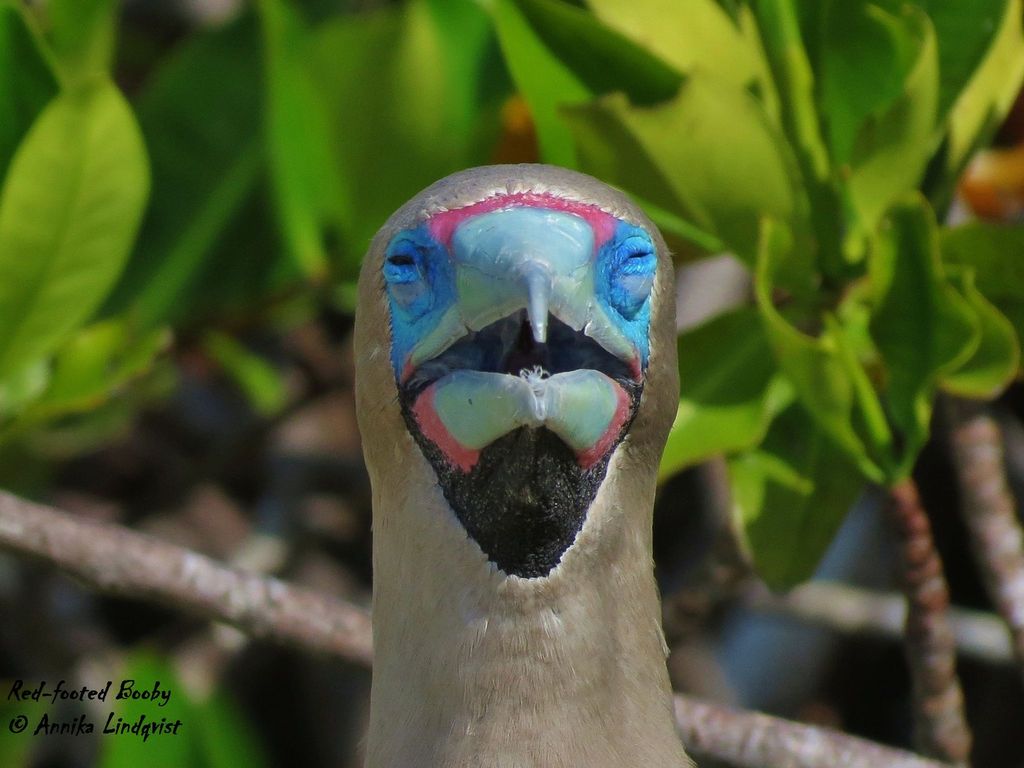


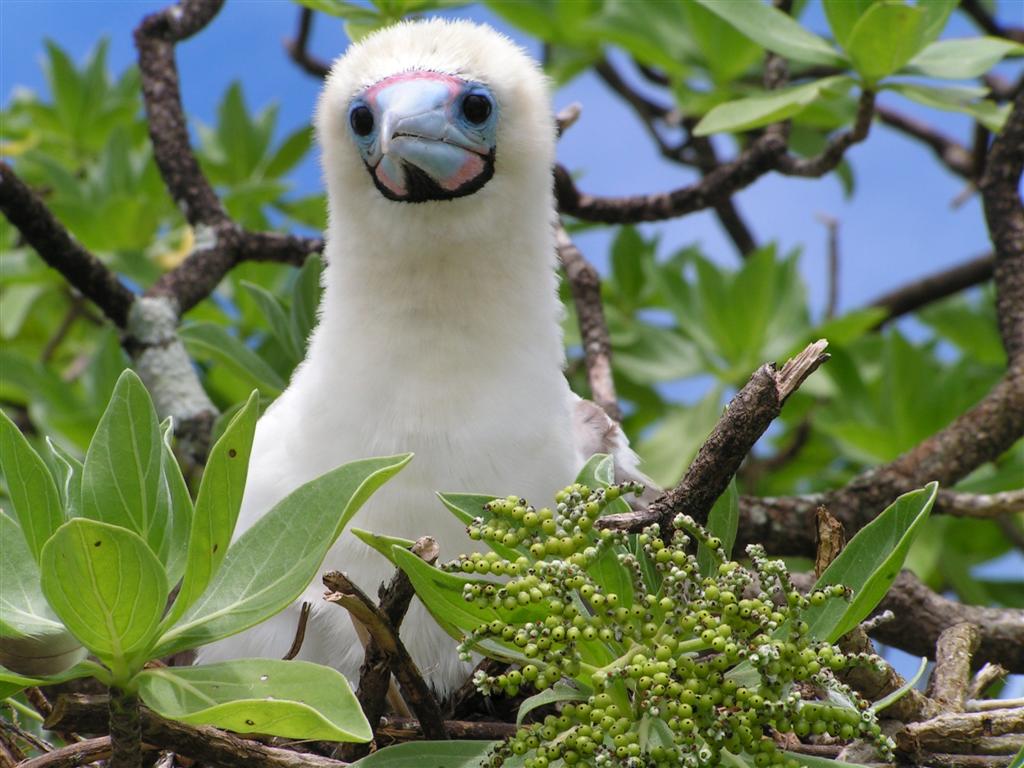
Photos show the species, not always the places on this page.
Length
About 70 cm (28 in) long. Wingspan is about 1 m (3.3 ft) according to Parks Australia and 91 to 101 cm (36 to 40 in) in the Animal Diversity Web, while Wikipedia lists up to 152 cm (60 in), so sources differ
Weight
About 840 to 1,000 g (1.9 to 2.2 lb): an average of 837 g was measured on Christmas Island and the Animal Diversity Web gives 900 to 1,003 g. Females are slightly larger than males
Next to a person
Shorter than an adult's arm span and about as heavy as a 1 kg bag of sugar
What it eats
Mostly fish such as flying fish and escolars, and squid. Most fish taken are 6 to 15 cm long and squid 6 to 10 cm. It dives straight into the sea from about 4 to 8 m up, and sometimes catches flying fish in the air. It can also hunt squid at night.
Around people
Calm, give space
How it lives
Red-footed boobies nest in colonies, in trees rather than on the ground like other boobies. A pair lays one chalky blue egg in a stick nest. Both adults incubate it for about 41 to 46 days, and the chick takes about three months to make its first flight. After a successful nesting, pairs breed again after about 11 to 15 months. NZ Birds Online says birds can live to at least 23 years.
Where it goes
Boobies nest in a colony and fly out over the sea to feed. GPS tags in the Seychelles showed most birds leaving at sunrise and returning at dusk, spending up to 12.5 hours at sea, while a few stayed out for up to 3 days and ranged within about 200 km of the colony. The Animal Diversity Web says they can hunt up to 150 km from shore. On the Cocos (Keeling) Islands they breed on North Keeling Island, which Pulu Keeling National Park describes as the only seabird breeding colony for 900 km.
We only draw a journey on the map when scientists have tracked it or clearly documented it. For this animal we have not found one yet.
Populations
IUCN lists the species as Least Concern, although Wikipedia notes the world population is decreasing and there are three subspecies. North Keeling Island has about 30,000 breeding pairs, roughly 6% of the global population, according to Pulu Keeling National Park. The park says numbers fell in the 20th century because of hunting and recovered after legal protection. In the Seychelles, surveys counted about 11,703 pairs in April 2019 and 10,344 pairs in November 2019 at Farquhar and St Francois atolls. Strong El Nino years can stop breeding: on Christmas Island, where usually 6,000 pairs nest, only about 30 pairs tried in 1982 and about 60 in 1983.
Meet it respectfully
Watch seabirds from a distance and never walk into a colony, handle a bird, or disturb a nest or chick. Never chase, feed or bait birds, and keep boats well back from nesting trees and islets. North Keeling Island is managed mainly for research and monitoring, access is by permit only, and all birds in Pulu Keeling National Park are protected under Australia's EPBC Act. I did not read viewing rules for the southern atoll, so follow local guidance. A sighting is never a promise.
Fun fact
Tap the bulb to light it up.
It is the smallest of the boobies.
Unlike most boobies, which nest on the ground, red-footed boobies nest in trees and bushes.
It can hunt farther from land than any other booby, up to about 150 km from shore.
Red-footed booby in the Ocean Atlas
Places we have researched where this animal is recorded. It is never guaranteed, and some places are for watching from the boat only.
Travel with usComing soonTrusted referralExploringOn pause, story onlyEthics pass
Country colour: pink where we travel, blue where we are exploring or refer, grey for story only.
 American Samoa
 Antigua and Barbuda
 Aruba
Aruba Australia
 The Bahamas
 Barbados
 Belize
 Brazil
 British Virgin Islands
 Cabo Verde
 Caribbean Netherlands
 Cayman Islands
 Chagos (British Indian Ocean Territory)
 Chile
Chile China
China Christmas Island
 Cocos (Keeling) Islands
 Colombia
 Cook Islands
 Costa Rica
 Cuba
Cuba Curaçao
 Dominica
 Dominican Republic
 Ecuador
 El Salvador
 Fiji
Fiji France
 French Polynesia
 Grenada
 Guadeloupe
 Guam
Guam Guatemala
 Haiti
Haiti Honduras
 Hong Kong
 India
India Indonesia
 Jamaica
 Japan
Japan Kenya
Kenya Kiribati
 Madagascar
 Maldives
 Marshall Islands
 Martinique
 Mauritius
 Mexico
 Micronesia (FSM)
 Montserrat
 Mozambique
 New Caledonia
 New Zealand
 Nicaragua
 Norfolk Island
 Northern Mariana Islands
 Palau
Palau Panama
 Papua New Guinea
 Philippines
 Pitcairn Islands
 Portugal
 Puerto Rico
 Saint Barthélemy
 Saint Helena
 Saint Kitts and Nevis
 Saint Lucia
 Saint Vincent and the Grenadines
 Samoa
Samoa São Tomé and Príncipe
 Senegal
 Seychelles
 Singapore
 Sint Maarten
 Solomon Islands
 South Africa
 Spain
Spain Taiwan
 Tanzania
 Thailand
 Timor-Leste
 Tonga
Tonga Trinidad and Tobago
 United Arab Emirates
 United Kingdom
 United States
 US Virgin Islands
 Vanuatu
 Venezuela
 Vietnam
 Wallis and Futuna
Sources for this page
- Pulu Keeling National Park, Red-footed booby
- Pulu Keeling National Park, Birds
- Parks Australia, 2026
- Wikipedia, Red-footed booby, 2026
- Wikipedia, Pulu Keeling National Park, 2026
- Animal Diversity Web, Sula sula
- NZ Birds Online, Red-footed booby
- SEYCCAT, Tracking red-footed booby
Facts checked 5 October 2026. Photos: Unsplash licence, or Creative Commons as shown on each photo.
Work in ocean travel?
We are always happy to hear from exceptional local operators, accommodation, conservation organisations and destination experts. If your work fits responsible, small-group ocean travel, we would love to learn more.
Partner with Ocean CallingSwim with humpback whales in Moʻorea, September 2027
from CHF 4,500