
Lionfish (red and common lionfish)
Pterois volitans and Pterois miles
Striped and slow-moving, native to the Indo-Pacific and invasive in the Atlantic and Mediterranean. Admire the fins from clear water and never touch the spines.
Least Concern (IUCN, year not confirmed) means it is not at high risk of extinction worldwide today.
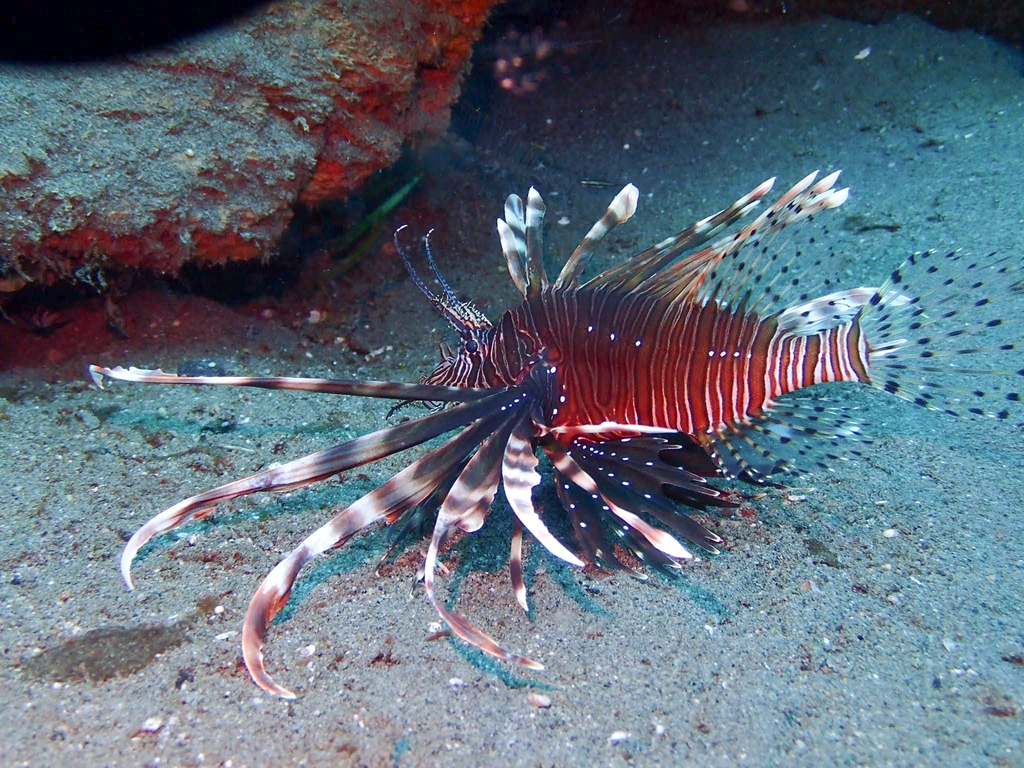
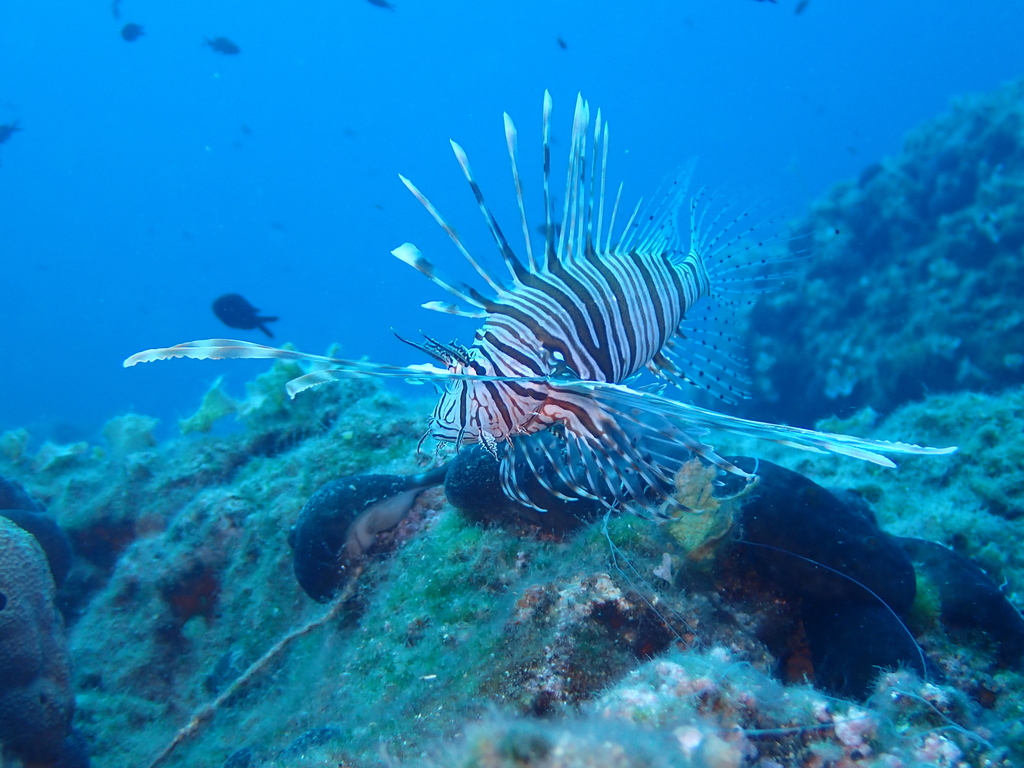
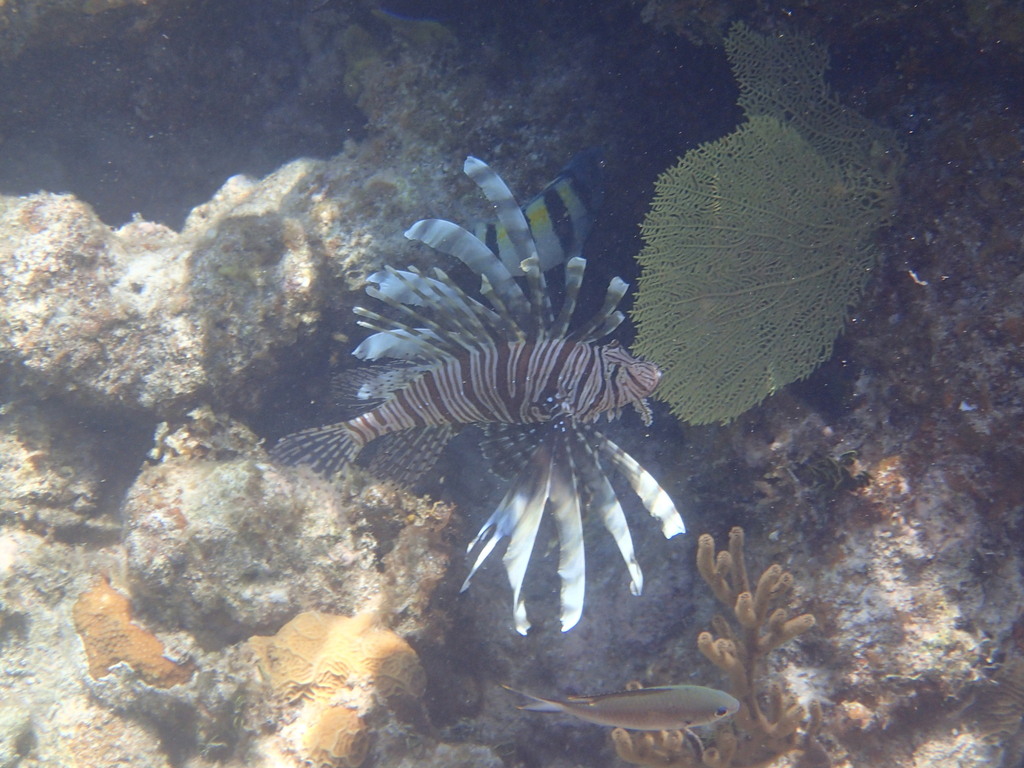
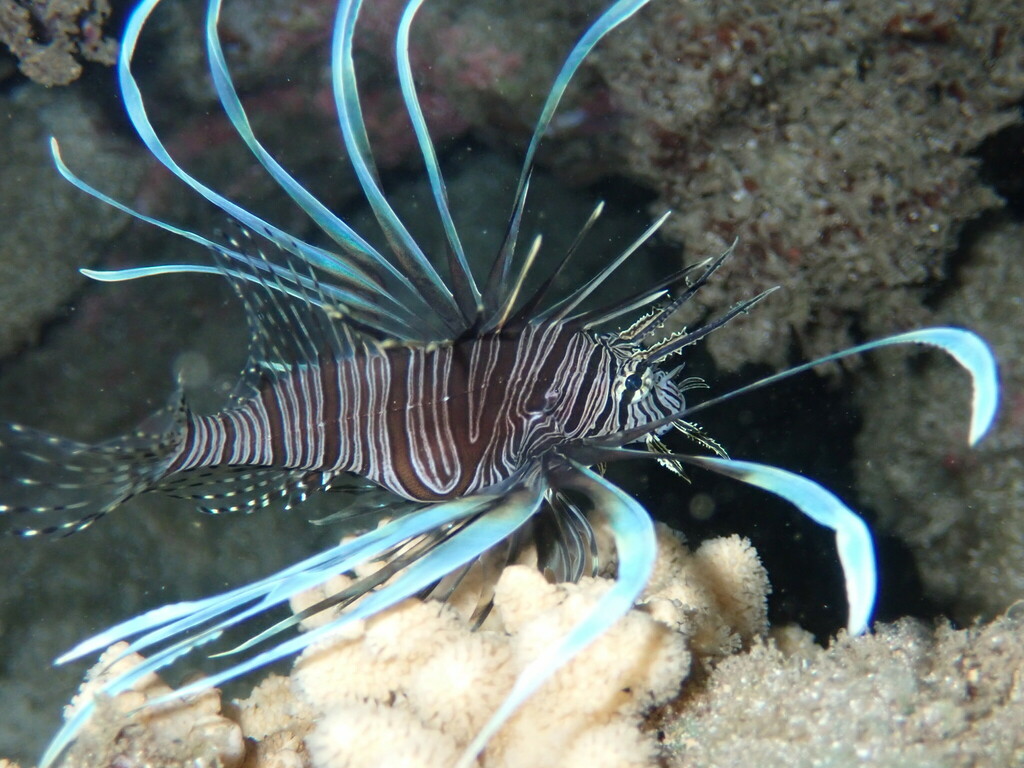
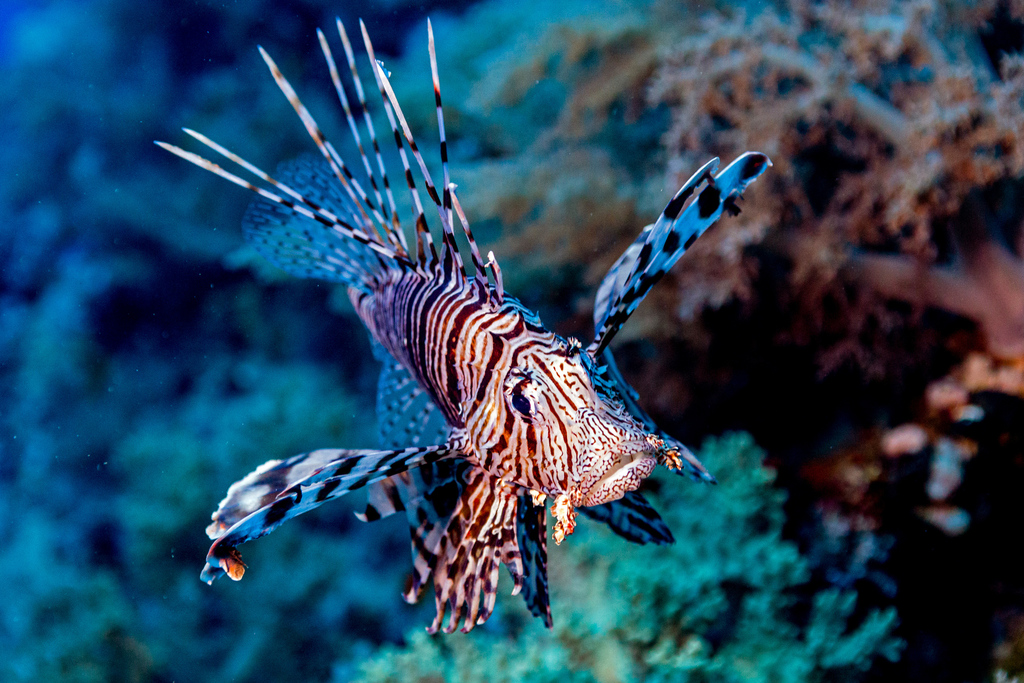
Photos show the species, not always the places on this page.
Length
Typical size varies by place, and fish in the native Indo-Pacific are often smaller. Largest recorded about 46 cm (18 in) for red lionfish and 43 cm (17 in) for common lionfish
Weight
Typical weight not reliably measured; largest recorded about 1.4 kg (3.1 lb) for red lionfish and about 0.8 kg (1.7 lb) for common lionfish
Next to a person
About as long as a forearm, with fins that look much bigger
What it eats
Small fish, shrimps and crabs. In their native range they hunt mostly at dusk and at night. In the Atlantic, where they are invasive, they also hunt by day and eat more than 50 kinds of fish.
Around people
Defensive if pressured
How it lives
In their native Indo-Pacific range, lionfish often hide by day and hunt at dusk and night, using their wide fins to push prey into a corner and swallow it in one go. The long spines carry venom for defence, not for hunting. In the invaded Atlantic they are often active by day too. There, a female can release about two million eggs a year.
Where it goes
Adults stay on their home reef. The big movement is the invasion, spread by drifting larvae and by people, not by adults migrating. First Atlantic record off Florida in 1985; established from Miami to North Carolina by 2002; Bermuda 2004, Bahamas 2005, Cuba 2007, Jamaica and Dominican Republic 2008, Gulf of Mexico 2009. In the Mediterranean: Israel 1991, then Lebanon 2012, Turkey, Cyprus, Greece and Italy 2014 to 2015.
We only draw a journey on the map when scientists have tracked it or clearly documented it. For this animal we have not found one yet.
Populations
Two species are involved. In the Atlantic, most invaders are red lionfish, Pterois volitans, with a few common lionfish, Pterois miles, but some scientists think many are hybrids. In the Mediterranean, P. miles came in through the Suez Canal side, and by 2024 it was found from the eastern basin to single records in Croatia and in the Alboran Sea off Spain. Single records do not mean it lives there yet.
Meet it respectfully
Look, do not touch, and never corner, chase, bait or feed a lionfish for a photo. Our guests only watch. In the native Indo-Pacific range lionfish are wildlife, not a target. Where they are invasive, removal is done only by trained people where local law allows, and rules differ by place. In Florida, for example, no recreational licence is needed for a pole spear, Hawaiian sling or hand net. If stung, put the wound in the hottest water you can tolerate without burning (up to about 45°C), test it first on uninjured skin, and seek medical help. This is not medical advice.
Fun fact
Tap the bulb to light it up.
About 18 spines are venomous: 13 on the back, 3 under the tail end and 2 on the belly fins. The big fan fins are not venomous.
Lionfish stings are very painful, but deaths are very rare.
Clearfin and spotfin lionfish look similar, but they are different species that live only in the Indo-Pacific.
The first lionfish in the Atlantic was caught by a lobster fisher off Dania, Florida, in October 1985.
The first lionfish in the Mediterranean was caught by a trawler off Israel in 1991. It then went quiet for about 20 years before spreading fast from 2012.
Source: Bottacini et al., 2024, NeoBiota
Lionfish venom stays active even after the fish is dead, so handlers use puncture-proof gloves.
Lionfish (red and common lionfish) in the Ocean Atlas
Places we have researched where this animal is recorded. It is never guaranteed, and some places are for watching from the boat only.
Travel with usComing soonTrusted referralExploringOn pause, story onlyEthics pass
Country colour: pink where we travel, blue where we are exploring or refer, grey for story only.
 Albania
 Antigua and Barbuda
 Aruba
Aruba Australia
 The Bahamas
 Barbados
 Belize
 Bermuda
 Brazil
 British Virgin Islands
 Caribbean Netherlands
 Cayman Islands
 China
China Christmas Island
 Colombia
 Cook Islands
 Costa Rica
 Cuba
Cuba Curaçao
 Cyprus
 Dominica
 Dominican Republic
 Egypt
Egypt Fiji
Fiji French Polynesia
 Greece
 Grenada
 Guadeloupe
 Guam
Guam Haiti
Haiti Honduras
 Hong Kong
 India
India Indonesia
 Jamaica
 Japan
Japan Jordan
 Kenya
Kenya Madagascar
 Malaysia
 Maldives
 Marshall Islands
 Martinique
 Mauritius
 Mexico
 Micronesia (FSM)
 Mozambique
 New Caledonia
 New Zealand
 Nicaragua
 Northern Mariana Islands
 Palau
Palau Panama
 Papua New Guinea
 Philippines
 Puerto Rico
 Réunion
 Saint Lucia
 Saint Martin
 Samoa
Samoa Saudi Arabia
 Seychelles
 Sint Maarten
 Solomon Islands
 South Africa
 Sri Lanka
 Taiwan
 Tanzania
 Thailand
 Timor-Leste
 Tonga
Tonga Trinidad and Tobago
 Türkiye
 Turks and Caicos Islands
 United States
 US Virgin Islands
 Vanuatu
 Venezuela
 Vietnam
 Wallis and Futuna
Sources for this page
- USGS Nonindigenous Aquatic Species, Pterois volitans/miles
- Schofield, 2009, Aquatic Invasions
- Bottacini et al., 2024, NeoBiota
- NOAA Ocean Service, What is a lionfish?
- Florida Fish and Wildlife Conservation Commission, Lionfish
- Divers Alert Network, Hazardous marine life injuries
- FishBase, Pterois volitans
- Divers Alert Network, Lionfish stings
Facts checked 26 September 2026. Photos: Unsplash licence, or Creative Commons as shown on each photo.
Work in ocean travel?
We are always happy to hear from exceptional local operators, accommodation, conservation organisations and destination experts. If your work fits responsible, small-group ocean travel, we would love to learn more.
Partner with Ocean Calling