
Brown booby
Sula leucogaster
A dark seabird with a white belly, nesting on a rock in the sea. Sightings depend on the season and the weather, and none is ever a promise.
Least Concern (IUCN, 2018) means the species is not close to being threatened overall, because it is widespread with many colonies, although some colonies have been lost or shrunk.


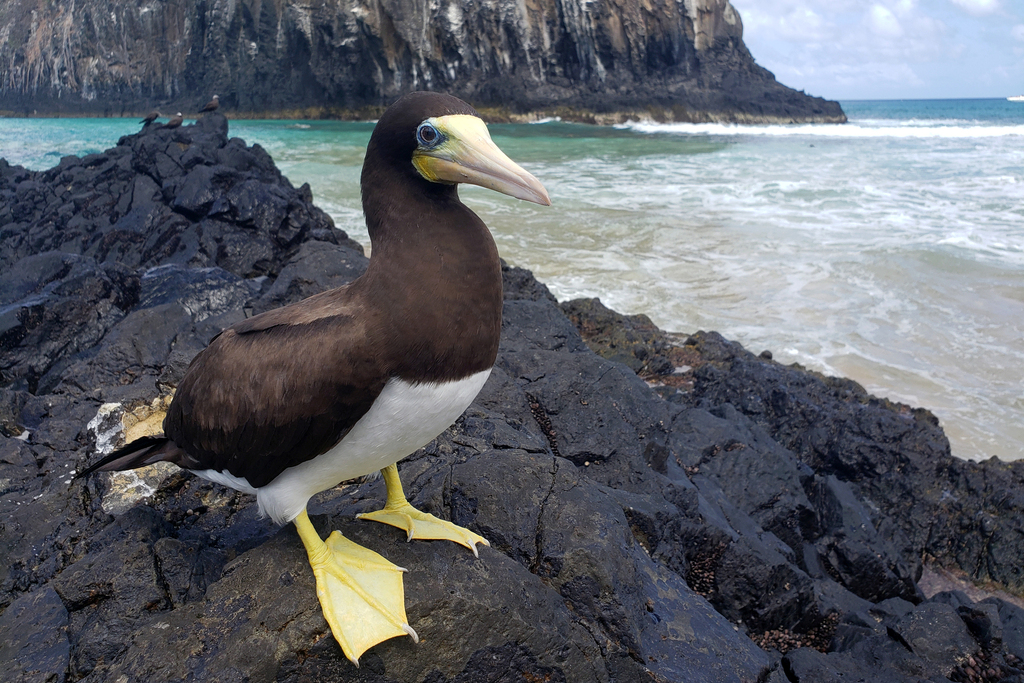
Photos show the species, not always the places on this page.
Length
About 64 to 85 cm (25 to 33 in) long, with a wingspan of about 130 to 155 cm (51 to 61 in)
Weight
Males about 950 to 1,700 g (2.1 to 3.7 lb); females are heavier, up to about 1,800 g (4 lb). Sources differ a little
Next to a person
With wings open, about as wide as a person is tall; it weighs about as much as one to two litres of water
What it eats
Mostly fish such as flying fish, mullet, halfbeaks and anchovies, plus squid. It plunge-dives from about 10 to 12 m and can go about 2 m under water. It sometimes steals food from other seabirds.
Around people
Quiet, keep distance
How it lives
Brown boobies nest on the ground in colonies, on islands, cays and atolls, from sea level to about 15 m. Pairs usually lay two eggs but raise only one chick. Incubation takes about 43 days and chicks fledge after roughly 95 to 120 days, then are fed for several more weeks. They often keep the same partner and first breed at about age four. The longest recorded life is 27.2 years.
Where it goes
Brown boobies fly out from their nesting colony to feed at sea and need prey within about 50 km of it. Young birds leave the colony after fledging and may not return for three or more years. The species ranges across tropical oceans between about 30°N and 30°S. In West Africa, Ile Alcatraz off Guinea holds the only known breeding colony between Cape Verde and Sao Tome and Principe.
We only draw a journey on the map when scientists have tracked it or clearly documented it. For this animal we have not found one yet.
Populations
Estimates of the world population differ: about 200,000 birds in Birds of the World and about 500,000 in the Audubon guide. IUCN lists it as Least Concern (2018). In 2024 the eastern Pacific birds were split off as a separate species, the Cocos booby, so Atlantic birds are not affected by that change. Australia held an estimated 59,940 to 73,900 breeding pairs in 1996 to 1997. At Ile Alcatraz in Guinea, a 1988 count gave about 3,000 pairs. Threats include introduced predators such as cats and rats, disturbance at nests, and El Nino years that cut food supply.
Meet it respectfully
Keep well back from nesting islets, because disturbance at colonies is a known threat. View from a boat at a distance, never land on a nesting rock, and never chase or flush birds. Keep drones away. Birds resting or feeding at sea can be watched quietly from a slow, steady boat. No sighting is ever promised.
Fun fact
Tap the bulb to light it up.
Males have a blue base to the bill and females a yellow one.
Pairs usually lay two eggs, but only one chick is raised.
It dives head first from about 10 to 12 m and can reach about 2 m under water.
Brown booby in the Ocean Atlas
Places we have researched where this animal is recorded. It is never guaranteed, and some places are for watching from the boat only.
Travel with usComing soonTrusted referralExploringOn pause, story onlyEthics pass
Country colour: pink where we travel, blue where we are exploring or refer, grey for story only.
 American Samoa
 Anguilla
 Antigua and Barbuda
 Aruba
Aruba Australia
 The Bahamas
 Barbados
 Belize
 Bermuda
 Brazil
 British Virgin Islands
 Cabo Verde
 Canada
 Caribbean Netherlands
 Cayman Islands
 Chagos (British Indian Ocean Territory)
 China
China Christmas Island
 Cocos (Keeling) Islands
 Colombia
 Cook Islands
 Costa Rica
 Cuba
Cuba Curaçao
 Denmark
 Djibouti
 Dominica
 Dominican Republic
 Egypt
Egypt Eritrea
 Fiji
Fiji France
 French Guiana
 French Polynesia
 Grenada
 Guadeloupe
 Guam
Guam Guatemala
 Guinea
 Haiti
Haiti Honduras
 Hong Kong
 India
India Indonesia
 Ireland
 Israel
 Italy
Italy Jamaica
 Japan
Japan Jordan
 Kiribati
 Madagascar
 Malaysia
 Marshall Islands
 Martinique
 Mexico
 Micronesia (FSM)
 Montserrat
 New Caledonia
 New Zealand
 Nicaragua
 Norfolk Island
 Northern Mariana Islands
 Oman
Oman Palau
Palau Panama
 Papua New Guinea
 Philippines
 Pitcairn Islands
 Portugal
 Puerto Rico
 Saint Barthélemy
 Saint Helena
 Saint Kitts and Nevis
 Saint Lucia
 Saint Martin
 Saint Vincent and the Grenadines
 Samoa
Samoa São Tomé and Príncipe
 Saudi Arabia
 Senegal
 Seychelles
 Singapore
 Sint Maarten
 Solomon Islands
 South Africa
 Spain
Spain Sri Lanka
 Suriname
 Sweden
 Taiwan
 Thailand
 Timor-Leste
 Tonga
Tonga Trinidad and Tobago
 Turks and Caicos Islands
 United Arab Emirates
 United Kingdom
 United States
 US Virgin Islands
 Vanuatu
 Venezuela
 Wallis and Futuna
 Yemen
YemenSources for this page
- IUCN Red List category via GBIF, 2018
- Animal Diversity Web, University of Michigan
- Australian Government, SPRAT
- Birds of the World, Conservation, Cornell Lab
- Birds of the World, Introduction, Cornell Lab
- Audubon Field Guide, Brown Booby
- BirdLife DataZone, Ile Alcatraz et Ile du Naufrage IBA
- Wikipedia, Brown booby
Facts checked 5 October 2026. Photos: Unsplash licence, or Creative Commons as shown on each photo.
Work in ocean travel?
We are always happy to hear from exceptional local operators, accommodation, conservation organisations and destination experts. If your work fits responsible, small-group ocean travel, we would love to learn more.
Partner with Ocean CallingNew: mobula rays in La Ventana, May 2027
CHF 2,720